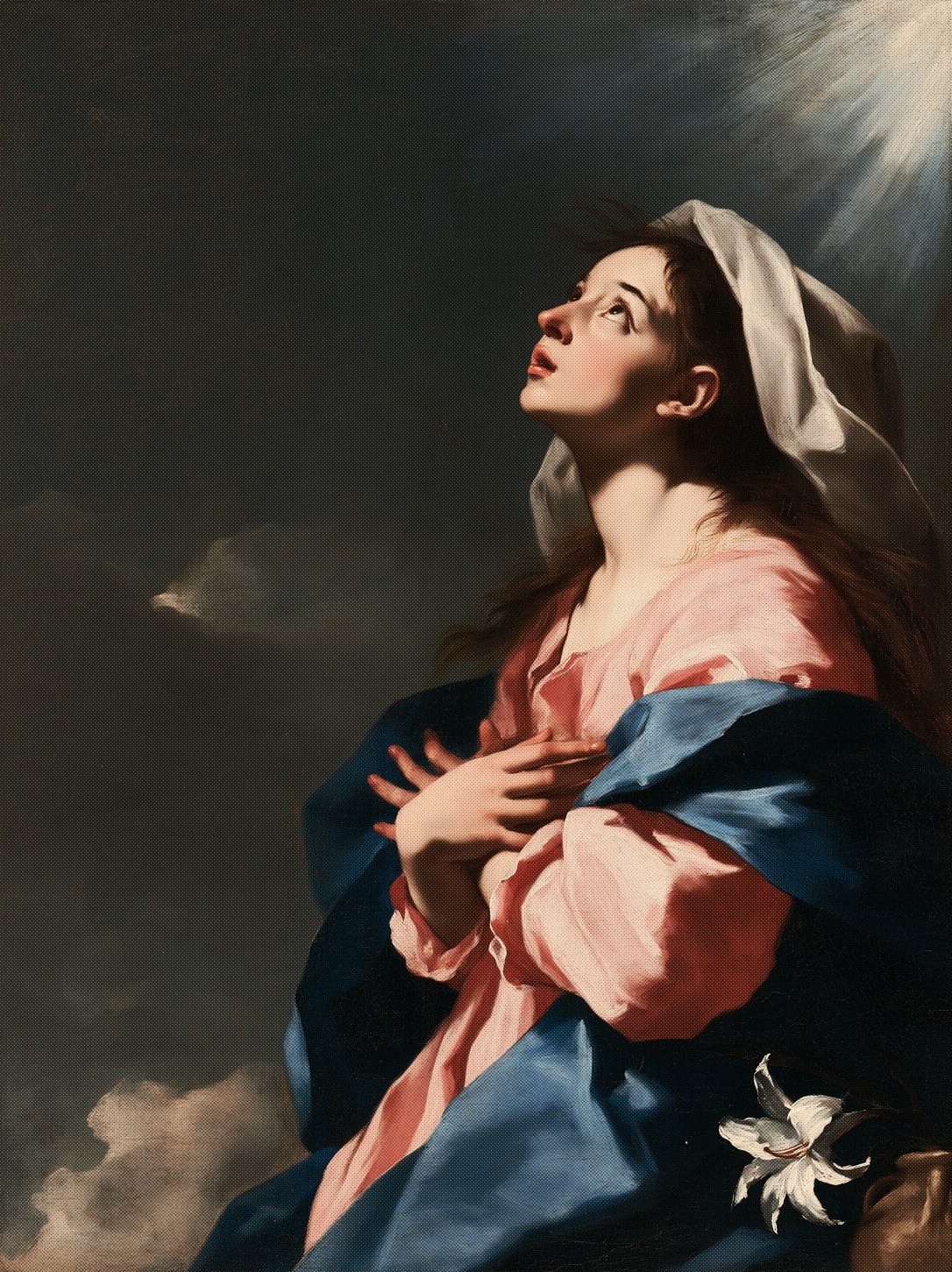
The Blessed Virgin Mary
- Born
- 1st century BC · Judea
- Died
- 1st century · Jerusalem or Ephesus
- Feast day
- 1 January
- Canonized
- Pre-Congregation
Mary was a young Jewish woman of Nazareth, a town in Galilee, who became the wife of Joseph and the mother of Jesus. The Gospels of Matthew and Luke say that God chose her, while she was still a virgin, to conceive Jesus through the Holy Spirit. Luke adds that the angel Gabriel brought her the news, and that she went to visit her relative Elizabeth, who greeted her as blessed among women.
Jesus was born in Bethlehem, and Mary and Joseph raised him in Nazareth. After that the Gospels show her only a few times and mostly in the background. She was in Jerusalem at his crucifixion, and she was with the apostles after his ascension. The Bible does not describe how her life ended. Catholic, Eastern Orthodox, and some other Christian traditions believe that at the end of her earthly life her body was taken up into heaven, a belief known in the West as the Assumption and in the East as the Dormition of the Mother of God. Traditions differ on whether this happened at Jerusalem or at Ephesus.
Christians have honored Mary since the earliest days of the Church. In 431 the bishops at the Council of Ephesus acclaimed her Theotokos, the God-bearer, because from her the Word took flesh and the Son of God came to live among people. Devotion has taken many forms: prayers and hymns, feast days in the liturgy, images and relics, churches built in her name, and pilgrimages to her shrines. The Catholic Church teaches two distinctive doctrines about her, her Immaculate Conception and her bodily assumption into heaven. Islam gives her the highest place among women, and a chapter of the Quran is named for her.
The solemnity of Mary, Mother of God, kept on 1 January, is the oldest Marian feast in the Western Church. It first took the place of the pagan New Year customs known as strenae, whose rites clashed with the holiness of Christian celebrations. A feast called the Natale Sanctae Mariae began to be kept in Rome around the sixth century, probably in connection with the dedication of Santa Maria Antiqua in the Roman Forum, one of the city's earliest churches in her honor. The day was tied to Christmas as the octave of the Nativity, and the Gospel of the circumcision of Jesus was read. A recent reform of the calendar restored the feast of her divine motherhood to 1 January. In the Church's teaching she is joined inseparably to her Son, and devotion to her always leads back to him.
Holy Mary, Mother of God, pray for us.
Media

EWTN

FOCUS Catholic

Ascension Presents

Bishop Robert Barron
Art
Theotokos of Vladimir
1125
Public domainThe Madonna in the Church
Jan van Eyck · 1430
Public domainVirgin of the Rocks
Leonardo da Vinci · 1483–1486
Public domainMadonna of the Goldfinch
Raphael · 1505
Public domainAssumption of the Virgin
Titian · 1517
Public domainDeath of the Virgin
Caravaggio · 1603
Public domain