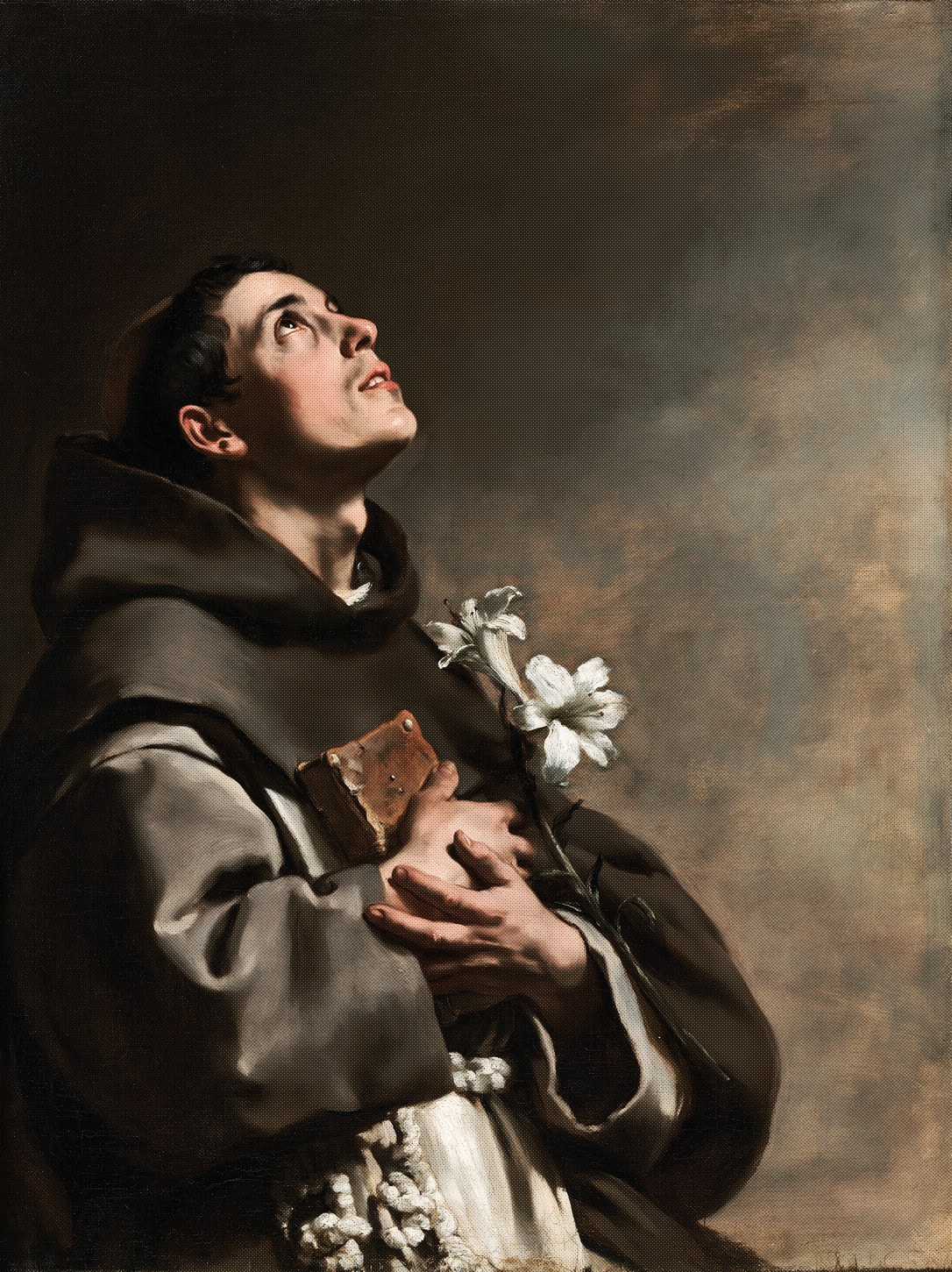
Saint Anthony of Padua
- Born
- 15 August 1195 · Lisbon, Portugal
- Died
- 13 June 1231 · Arcella, Padua, Italy
- Feast day
- 13 June
- Canonized
- 1 June 1232 · Pope Gregory IX
Patron of
- lost items
- Portugal
- Padua
- travelers
- sailors
- fishermen
- prisoners
- orphans
- poverty
- pregnancy
- people seeking a spouse
- the sick
Anthony of Padua was born Fernando Martins de Bulhões in Lisbon, usually dated to 1195, though some scholars argue that he was born several years earlier. His family was wealthy and noble, and he was educated at the cathedral school. At fifteen he entered the Canons Regular at the Abbey of Saint Vincent, on the edge of Lisbon. Visits from relatives and friends distracted him, so around 1212 he asked to be moved to the order's motherhouse, the Monastery of the Holy Cross at Coimbra, then the capital of Portugal. There he studied theology and Latin, and he was ordained a priest.
Near Coimbra a group of Franciscan friars had settled in a small hermitage dedicated to Saint Anthony the Great. Fernando was drawn to their simple, evangelical life, in an order that had been founded only a few years before. In 1220 news came that five Franciscans had been beheaded in Morocco, the first of their order to be killed. King Afonso II of Portugal ransomed their bodies, and they were buried at Coimbra as martyrs. Inspired by their example, Fernando obtained permission to leave the canons and join the friars. He entered the hermitage at Olivais and took the name Anthony, from its chapel.
He set out for Morocco, as the martyrs had, but fell seriously ill there and sailed for home. The ship was blown off course and landed in Sicily. Anthony made his way north and was invited to the general chapter of the Franciscans at Assisi, where he heard Francis speak but did not meet him in person. He then spent about a year and a half at the hermitage of Montepaolo. At Francis's direction he began to preach in Romagna and afterward in northern Italy and France, and he taught theology to his fellow friars. In 1227 he became provincial of northern Italy.
He died on 13 June 1231 at Arcella, on the outskirts of Padua. Less than a year later, in 1232, Pope Gregory IX canonized him, and the basilica in Padua that bears his name holds his shrine. He was later named a Doctor of the Church. His sermons were admired for their learning and the polish of their style. Devotion to him spread widely, and people still invoke him as the patron of Portugal and Padua, of travelers and prisoners, and of anyone looking for something that has been lost.
Saint Anthony of Padua, pray for us.
Media

Divine Mercy

EWTN

EWTN

Divine Mercy
Art
Saint Anthony of Padua
Cosimo Tura · 1484
Public domainSaint Anthony Preaching to the Fishes
Garcia Fernandes · 1525
Public domainSaint Anthony of Padua
El Greco · 1580
Public domainSaint Anthony Preaching to the Fish
Paolo Veronese · 1580
Public domainSaint Anthony of Padua with the Child
Bartolome Esteban Murillo · 1668
Public domainSaint Anthony of Padua with the Infant Christ
Giovanni Battista Tiepolo · 1767
Public domain