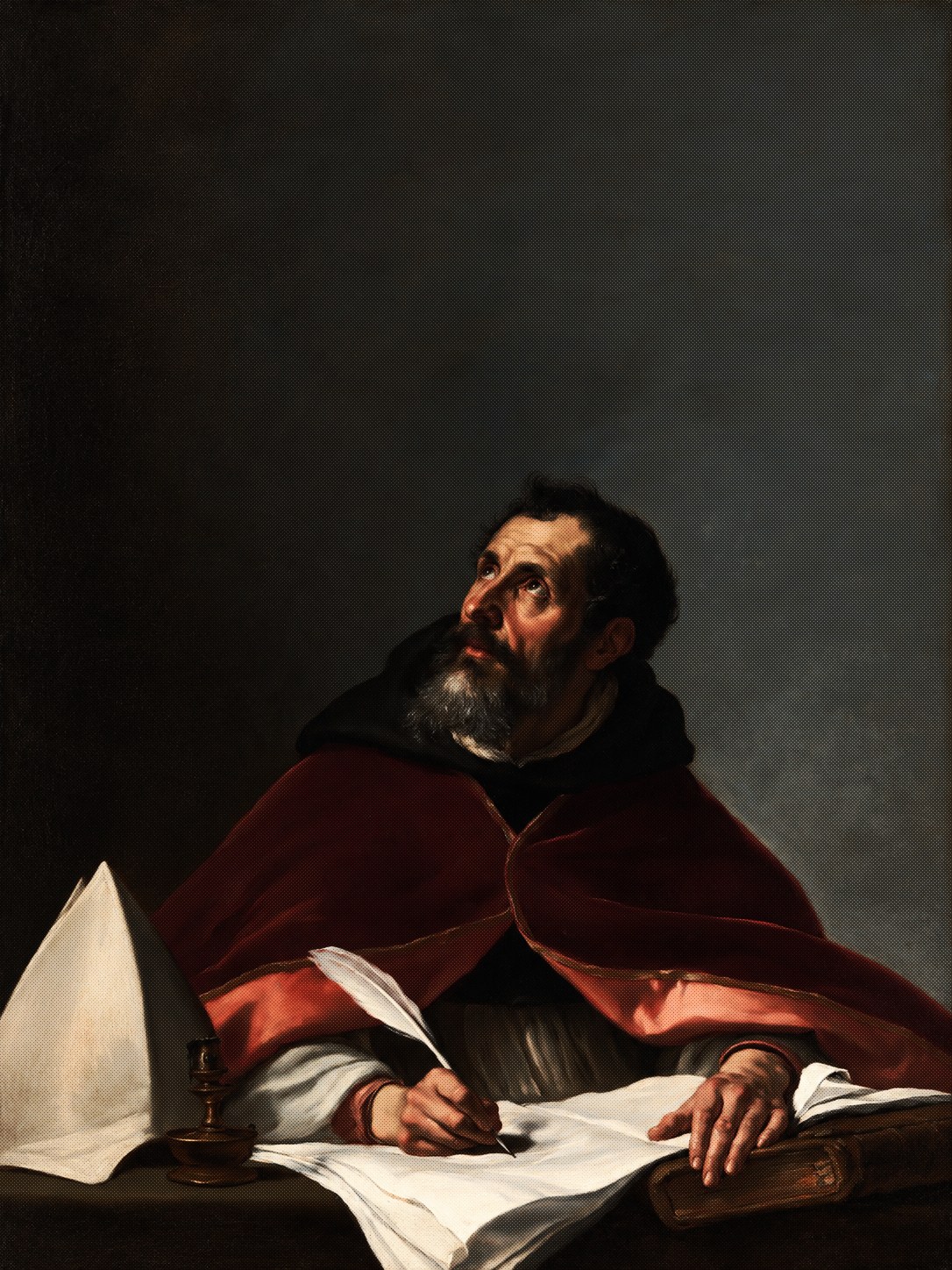
Saint Augustine of Hippo
- Born
- 13 November 354 · Thagaste, Numidia (Souk Ahras, Algeria)
- Died
- 28 August 430 · Hippo Regius, Numidia (Annaba, Algeria)
- Feast day
- 28 August
- Canonized
- Pre-Congregation
Patron of
- brewers
- printers
- theologians
- philosophers
- sore eyes
- protection against harmful animals
- Salford, England
- Southwark, England
- Tarbes, France
- Ostia
- Carpineto Romano
- Bridgeport, Connecticut
Augustine wrote that he came to God late, and the story of how he got there is one of the most famous in Christian history. "Late have I loved you, beauty so ancient and so new," he told God in his Confessions, describing a life in two parts. First came the restless wandering of a man who looks for the right road and makes many mistakes. Then came the burning desire of someone who has found it and longs to arrive.
He was born on 13 November 354 in Thagaste, in Roman Numidia, now Souk Ahras in Algeria, to a family of modest landowners. His father, Patricius, was a pagan. His mother, Monica, was a Christian who gave him a religious upbringing but, as was common then, did not have him baptized as a child. After his early schooling at Thagaste and nearby Madaura, he went to Carthage in 371 with the help of a wealthy patron named Romanianus. He was sixteen, lively and headstrong, and in Carthage he began living with a young woman of the city, who bore him a son, Adeodatus, in 372. The relationship is said to have lasted some fourteen years.
Reading Cicero's Hortensius turned him toward philosophy, and for a time he followed the Manichaeans. His search later led him to Neoplatonism and then to Milan, where he met Bishop Ambrose. It was Ambrose who baptized him. All the while his mother had been weeping and praying for him, and her patience was slowly bearing fruit.
Augustine returned to Africa hoping to form a community of monks who would give themselves to God and the study of Scripture. After his mother's death he went to Hippo, where he was ordained a priest and then made bishop. For thirty-four years he taught his flock through sermons and writings. He argued against the errors of his day, including the Donatists, against whom he insisted that the sacraments are valid whatever the merits of the minister.
His books are still read, printed, and studied. The Confessions is often called the first autobiography in the Western tradition. The City of God, written as the Roman world in the West was breaking apart, set the Church apart as a spiritual city, and On the Trinity and many other works explored faith, grace, and Scripture. Augustine died in Hippo on 28 August 430, while the Vandals were besieging the city. The Church honors him as a Doctor of the Church, a thinker who stands as a bridge between Africa and Europe.
Saint Augustine of Hippo, pray for us.
Media

Bishop Robert Barron

Breaking In The Habit
EWTN News
Catholic Online
Art
Saint Augustine and Alypius Receiving Ponticianus
Niccolo di Pietro · 1414
Public domainVision of Saint Augustine
Filippo Lippi · 1452
Public domainSaint Augustine
Sandro Botticelli · 1480
Photo by Sailko · CC BY 3.0Saint Augustine
Carlo Crivelli · 1486
Photo by Sailko · CC BY-SA 3.0Saint Augustine in His Study
Vittore Carpaccio · 1502
Public domainSaint Augustine
El Greco · 1590
Public domain