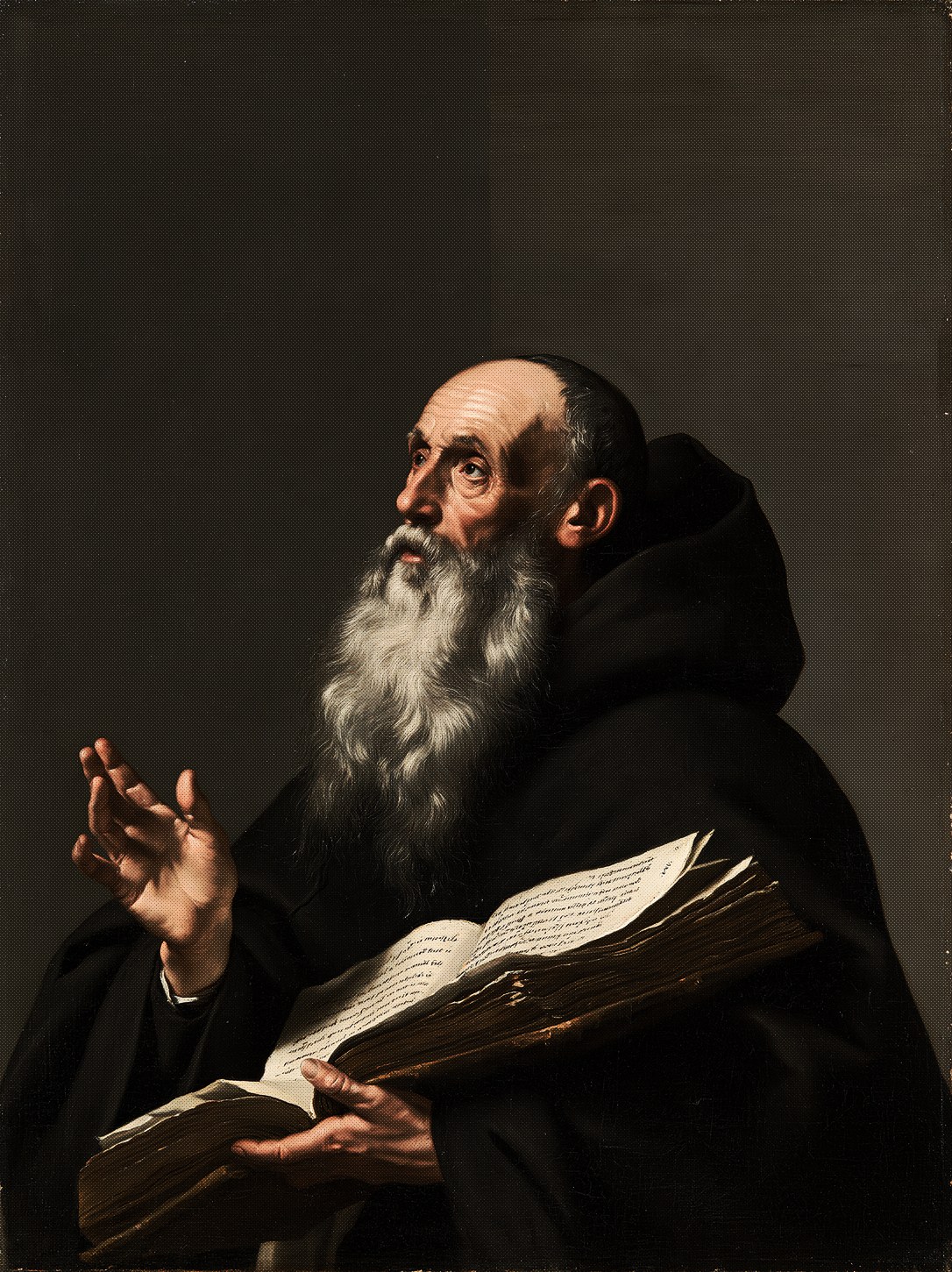
Saint Benedict of Nursia
- Born
- c. 480 · Nursia (Norcia), Umbria, Italy
- Died
- c. 547 · Monte Cassino, Italy
- Feast day
- 11 July
- Canonized
- 1220 · Pope Honorius III
Patron of
- Europe
- against poison
- farmers
- the dying
- speleologists
- engineers
- architects
- Norcia
- Cassino
- Subiaco
- Montecassino
- Diocese of Spoleto-Norcia
Almost everything known about Benedict comes from one source, the second book of the Dialogues of Pope Gregory the Great, written around 593. Gregory did not write a biography in the modern sense. He painted a spiritual portrait of a gentle, disciplined abbot, drawing on what he had heard from a handful of Benedict's disciples. Modern scholars debate the work's authenticity, and Benedict's dates are not secure.
According to Gregory, Benedict was born around 480 into a good family near Norcia in Umbria, and his parents sent him to Rome to be educated. There he found students who had sunk into vice, and he left the city. He went first to a place called Enfide and then lived for three years as a hermit in a cave at Subiaco, a spot that later became the monastery of the Sacro Speco. Gregory describes him as a bright light in a dark age. The solitude was followed by a period of community life. At Subiaco he gathered disciples and founded twelve small communities of monks. Later he moved to Monte Cassino, where among the ruins of an old pagan acropolis he and his followers built the first abbey.
Tradition has attributed many miracles to him, but his most lasting work is the Rule he wrote around 530. It is a short manual of prayer and common life in seventy-three chapters, written in a plain and familiar voice. It begins by asking the reader to listen with the ear of the heart, and it urges the monk never to despair of God's mercy. The Rule draws on John Cassian and on an earlier text called the Rule of the Master, but it has its own spirit of balance and moderation. Prayer and the reading of Scripture alternate with manual work, in a setting of mutual service and charity.
He is said to have been the brother of Saint Scholastica. The Roman Martyrology believes he died on 21 March, though the year is uncertain and sources place it between the 540s and about 560. Within two centuries more than a thousand monasteries followed his Rule, and centers of prayer, learning, and hospitality for the poor and for pilgrims sprang up across Europe. Pope Paul VI named him a patron of Europe in 1964.
Saint Benedict of Nursia, pray for us.
Media

EWTN

Bishop Robert Barron

Ascension Presents
EWTN News
Art
Saint Andrew and Saint Benedict with the Archangel Gabriel
Agnolo Gaddi · shortly before 1387
Public domainSaint Benedict
Antonello da Messina · 1470
Public domainSaint Benedict Moves to the Hermitage of Effide
Antonio Solario · c. 1515
Public domainSaint Benedict
El Greco · 1577
Public domainDeath of Saint Benedict
Domenico Maria Canuti · 1667
Public domainSaint Benedict and the Angel
Domenico Maria Canuti
Photo by Sailko · CC BY 3.0