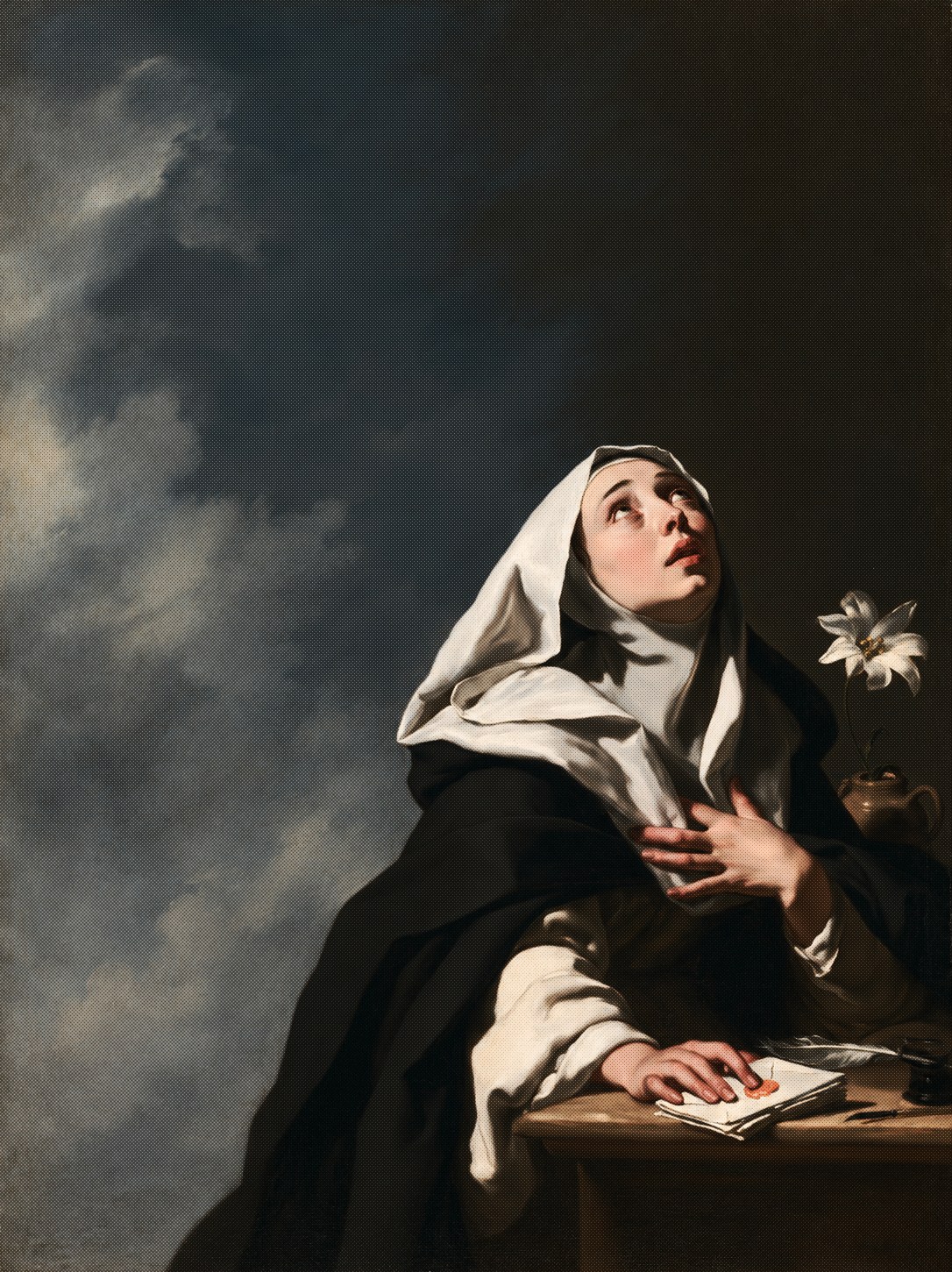
Saint Catherine of Siena
- Born
- 25 March 1347 · Siena, Italy
- Died
- 29 April 1380 · Rome, Italy
- Feast day
- 29 April
- Canonized
- 29 June 1461 · Pope Pius II
Patron of
- Italy
- Europe
- Rome
- Italian Catholic Action
- nurses
- sick people
- people ridiculed for their piety
- protection against fire
- Varazze, Italy
Catherine of Siena addressed popes, queens, and prisoners in letters she mostly dictated rather than wrote herself. She was born in the Fontebranda district of Siena on 25 March 1347, the twenty-fourth of twenty-five children of Jacopo Benincasa, a dyer, and his wife Lapa di Puccio de' Piacenti. Her twin sister, Giovanna, died as a newborn. The family belonged to Siena's small middle class.
Her devotion began early. At six she is said to have seen Christ robed as a pope, with Peter, John, and Paul beside him, and at seven she vowed to remain a virgin. Prayer, penance, and fasting filled her days, leaving little room for play. When her parents began to talk of marriage, about the time she turned twelve, she refused, and she held to it. All she asked for was a small room, which became her cell as a Dominican tertiary, one of the women known as Mantellate for their white habit and black mantle.
That little room became a gathering place for artists, scholars, and clergy, many of them better educated than she was. They were called the Caterinati. She learned to read and write, but most of her messages were dictated. Through them she spoke to popes and kings, to housewives and queens, and to prisoners.
She lived in a Tuscany rich in art and letters but torn by feuds between Guelfs and Ghibellines, and she worked for peace. She went to Avignon during the dispute between Florence and the papacy, and her influence with Pope Gregory XI is credited with helping persuade him to leave Avignon for Rome in 1376. He later sent her to Florence to negotiate, and peace was reached in July 1378. Between 1377 and 1378 she dictated The Dialogue of Divine Providence, her great work of spiritual teaching. When the Great Schism split the Church, she went to Rome and wrote to princes and cardinals urging obedience to Pope Urban VI.
She died in Rome on 29 April 1380, worn out by severe fasting, and was buried in Santa Maria sopra Minerva. Devotion grew quickly, and Pope Pius II canonized her in 1461. She was named a patron of Rome in 1866, of Italy alongside Francis of Assisi in 1939, and of Europe in 1999. In October 1970 Paul VI declared her a Doctor of the Church, the second woman so honored, only days after Teresa of Ávila. She is remembered for the Dialogue, her hundreds of letters, and her dozens of prayers, and for the part she took in the affairs of the papacy, which was rare for a woman of her century.
Saint Catherine of Siena, pray for us.
Media

Bishop Robert Barron

Augustine Institute

EWTN

Divine Mercy
Art
The Miraculous Communion of Saint Catherine of Siena
Giovanni di Paolo · 1450
CC0Saint Catherine of Siena Exchanging Her Heart with Christ
Giovanni di Paolo · 1460
CC0The Mystic Marriage of Saint Catherine of Siena
Fra Bartolomeo · 1511
Public domainSaint Catherine of Siena Receiving the Stigmata between Saints Benedict and Jerome
Domenico Beccafumi · 1515
Public domainChrist on the Cross with Saint Catherine of Siena, Saint Dominic and an Angel
Anthony van Dyck · 1620
Public domainSaint Catherine of Siena
Giovanni Battista Tiepolo
Public domain