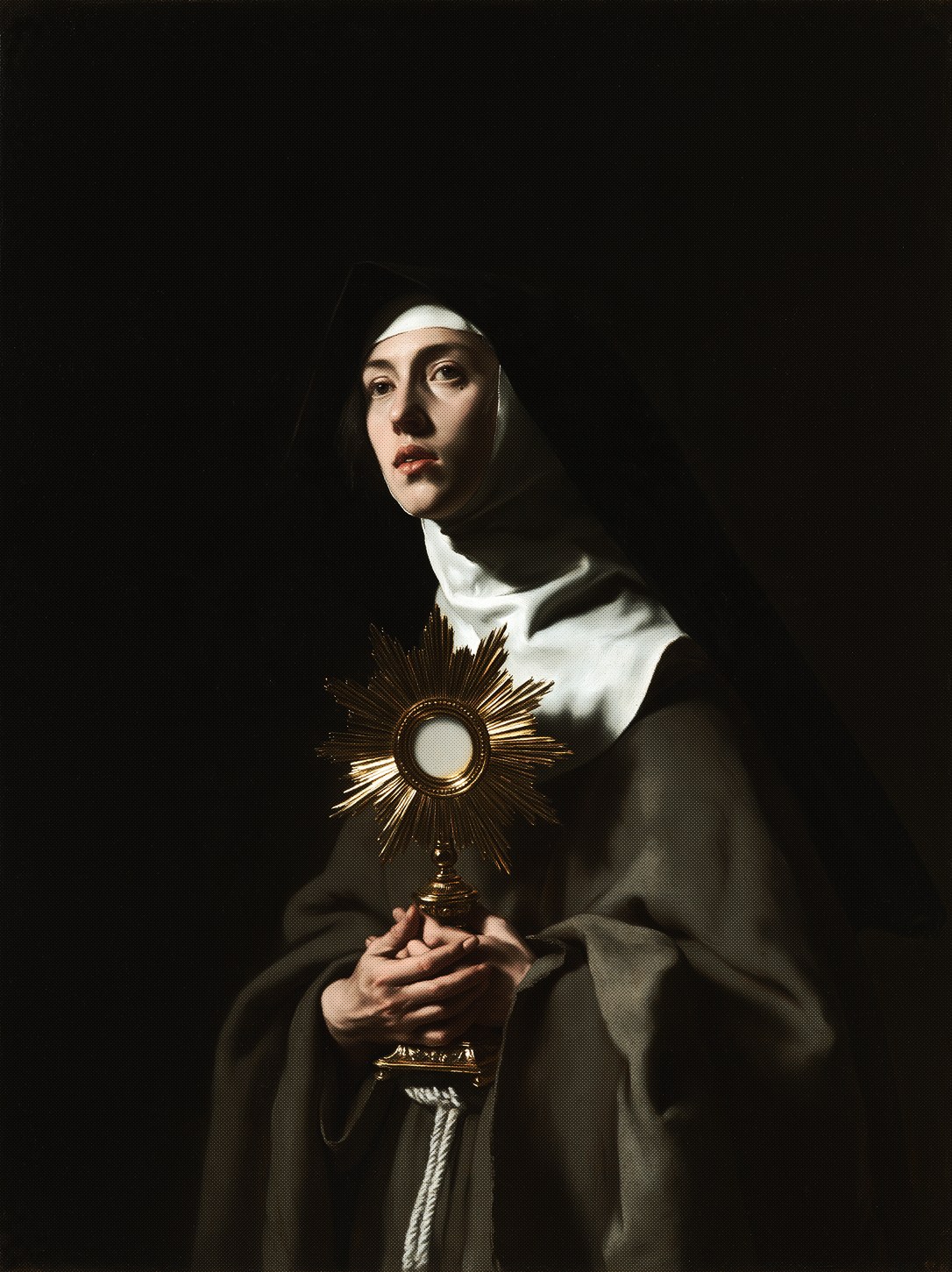
Saint Clare of Assisi
- Born
- 16 July 1194 · Assisi, Italy
- Died
- 11 August 1253 · Assisi, Italy
- Feast day
- 11 August
- Canonized
- 12 August 1255 · Pope Alexander IV
Patron of
- television
- eye diseases
- laundry workers
- glassmakers
- embroiderers
- goldsmiths
- good weather
- Iglesias, Italy
- San Gavino Monreale, Italy
- Santa Clara, California
Clare was born in Assisi in 1194 into the wealthy and noble Offreduccio family. According to traditional accounts, her father, Favarone, owned a palace in the town and a castle on the slope of Mount Subasio. Her mother, Ortolana, was a devout woman who had made pilgrimages to Rome, Santiago de Compostela, and the Holy Land. A family tradition says that before the birth Ortolana heard a voice promise her a daughter who would be a clear source of light to the world, and so the child was named Chiara.
When Clare was about twelve, her parents wanted her to marry a wealthy young man, and she protested that she would not marry until she was eighteen. In those years she heard Francis of Assisi preach during Lent in the church of San Giorgio, and his simplicity and his poverty among the people stayed with her. As marriage drew closer, she went to Francis and asked him to help her live according to the Gospel.
On the night of Palm Sunday, 20 March 1212, with the consent of the bishop of Assisi, she left her father's house and went to the Porziuncola, a small chapel where she found Francis and his brothers. There he cut off her long hair and gave her a rough habit, and she made vows of obedience, chastity, and poverty. She took refuge in the Benedictine monastery of San Paolo near Bastia Umbra, where her father tried without success to bring her home, and then settled at San Damiano. There she founded the order of the Poor Ladies, later called the Poor Clares, and was named its abbess. Her sisters Agnes and Beatrice joined her, and later their widowed mother did as well.
The sisters lived by a very strict rule. They trusted in Providence, lived on alms, and gave their days to prayer. Francis first dictated a rule for them, and Clare later wrote the definitive one, asking Pope Gregory IX for the privilege of poverty and receiving it. It is the first monastic rule known to have been written by a woman.
For many years she guided her sisters with plain, humble wisdom. According to the traditional account, in 1240 the army of Frederick II came against the walls of Assisi, and Clare, though very ill, asked to be brought to meet it holding the monstrance with the Blessed Sacrament. The attackers, the story says, were dazzled by its light and fled. She died in Assisi on 11 August 1253, twenty-seven years after Francis, and Pope Alexander IV canonized her two years later. Franciscans think of her as the second light after Francis. She is invoked against diseases of the eyes and honored as a patron of television, glassmakers, and embroiderers.
Saint Clare of Assisi, pray for us.
Media

Franciscan Media

EWTN

Catholic Online

EWTN News
Art
The Investiture of Saint Clare
Giovanni di Paolo · 1457
Public domainSaint Clare Rescuing the Shipwrecked
Giovanni di Paolo · 1457
Public domainSaints Bernardino and Clare
Carlo Crivelli · 1480
Public domainThe Death of Saint Clare
Bartolome Esteban Murillo · 1645
Public domainSaint Clare
Eleanor Fortescue-Brickdale · 1919
Public domainSaint Clare Holding a Monstrance
Alonso del Arco
Public domain