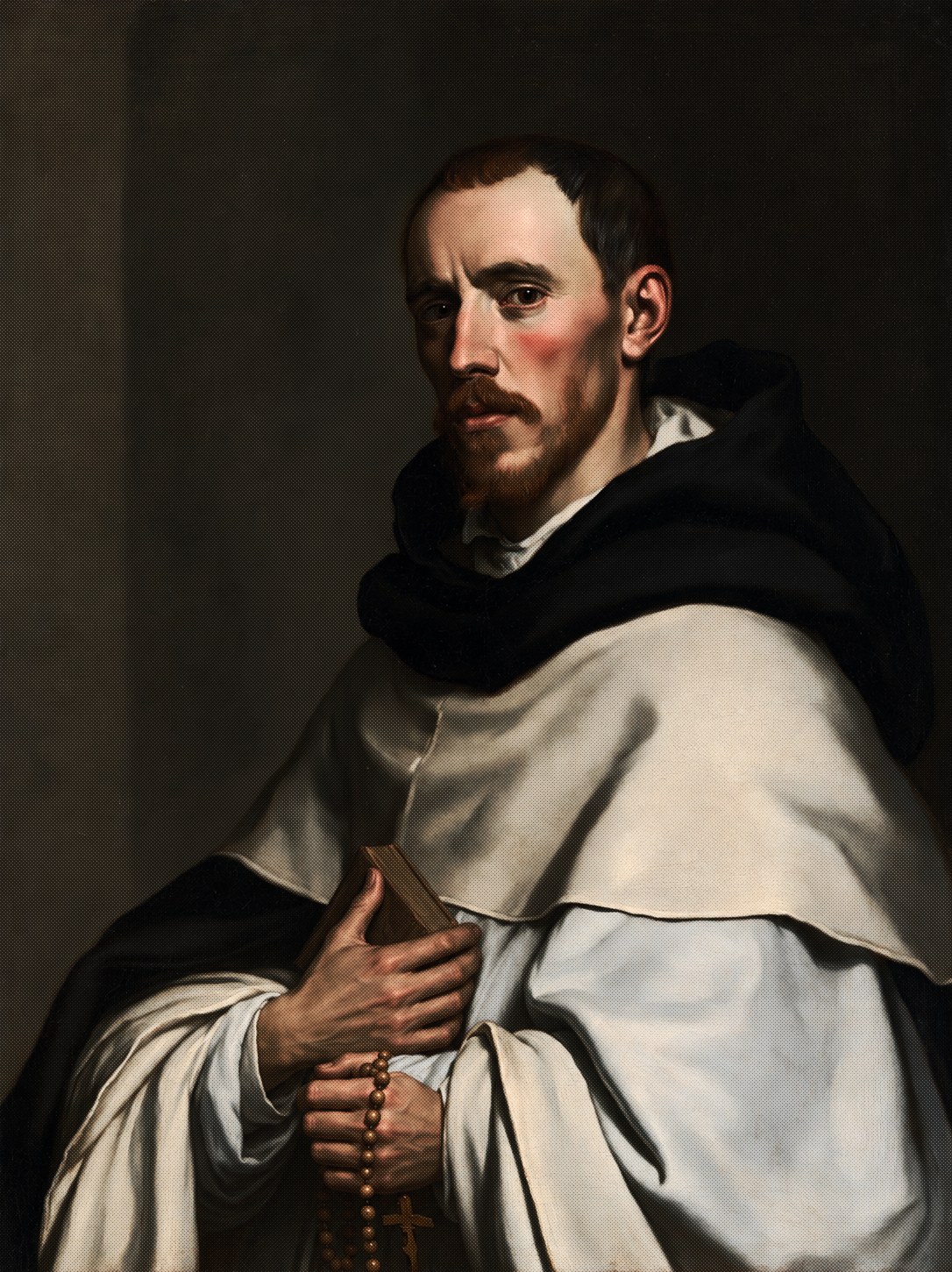
Saint Dominic de Guzmán
- Born
- c. 1170 · Caleruega, Old Castile, Spain
- Died
- 6 August 1221 · Bologna, Italy
- Feast day
- 8 August
- Canonized
- 3 July 1234 · Pope Gregory IX
Patron of
- astronomers
- natural scientists
- Dominican Republic
- Managua
- Valletta
- Birgu
- Burgos
- Archdiocese of Fuzhou
- Santo Domingo Pueblo
- Campana
- Augusta
- Soriano Calabro
One of the first people to describe Dominic did it with the eye of a woman who had received the habit from him. Cecilia Cesarini remembered him as of middle height and slender, with a handsome, rosy face and eyes she thought beautiful, his hair and beard tending toward red. A kind of radiance seemed to come from his forehead and made everyone respect and like him. He stayed serene and smiling except when he grieved over some trouble of a neighbor, and he had long, fine hands and a strong, harmonious voice. His tonsure was complete, sprinkled with a few white hairs.
He was born around 1170 at Caleruega, in Old Castile, to Felix de Guzmán and Joan of Aza, who is also honored as a blessed. A later tradition says that before his birth his mother dreamed of a dog leaping from her womb with a burning torch in its mouth. The story probably grew up after his order became known as the Dominicans, since the Latin word suggests a pun, "dog of the Lord." As a boy he was entrusted to an uncle, an archpriest, who taught him the first lessons of learning and faith. In his mid-teens he went to Palencia, where he spent six years in the liberal arts and four in theology. During the famine of 1191 he gave away his money to help the hungry.
After his studies he was ordained a priest and, around 1196 or 1197, joined the chapter of canons at Osma at the invitation of its prior, Diego de Azevedo. His early years there were marked by study, prayer, and quiet. Dante, writing about a century later, called him a farmer whom Christ chose to help in his garden. In 1201 Diego became bishop of Osma and had to travel on a mission to Denmark. He took Dominic as his companion, and near Toulouse the two travelers saw how far the Cathar heresy had spread.
What Dominic saw there set the course of his life. He worked as a humble preacher in regions upset by the Albigensian heresy and chose to live in the barest poverty, always talking with God or about God. Convinced that the clergy had to return to the austere life that the heretics claimed for themselves, he founded the Order of Preachers at Toulouse. It was built on the Rule of Saint Augustine but turned out to be something quite new. Its friars were to preach as they traveled, live by begging, which was a first for an order of clergy, keep many monastic observances, and study deeply. Dominic urged his brothers to serve their neighbors through prayer, study, and the ministry of the word. He and the Dominicans are traditionally credited with spreading the rosary.
Worn out by his labor, Dominic died at Bologna on 6 August 1221. Pope Gregory IX canonized him on 3 July 1234 at Rieti, and his tomb is in the Basilica of San Domenico in Bologna. He is remembered as the founder of an order that put learning at the service of preaching.
Saint Dominic de Guzmán, pray for us.
Media

Matt Fradd

Catholic Online

EWTN
Art
Saint Dominic Adoring the Crucifixion
Fra Angelico · 1443
Public domainSaint Dominic
Carlo Crivelli · 1472
CC0Saint Dominic and the Albigensians
Pedro Berruguete · 1496
Public domainPortrait of Fra Teodoro of Urbino as Saint Dominic
Giovanni Bellini · 1515
Public domainSaint Dominic
Titian · 1565
Public domainSaint Dominic in Prayer
El Greco · 1600
Public domain