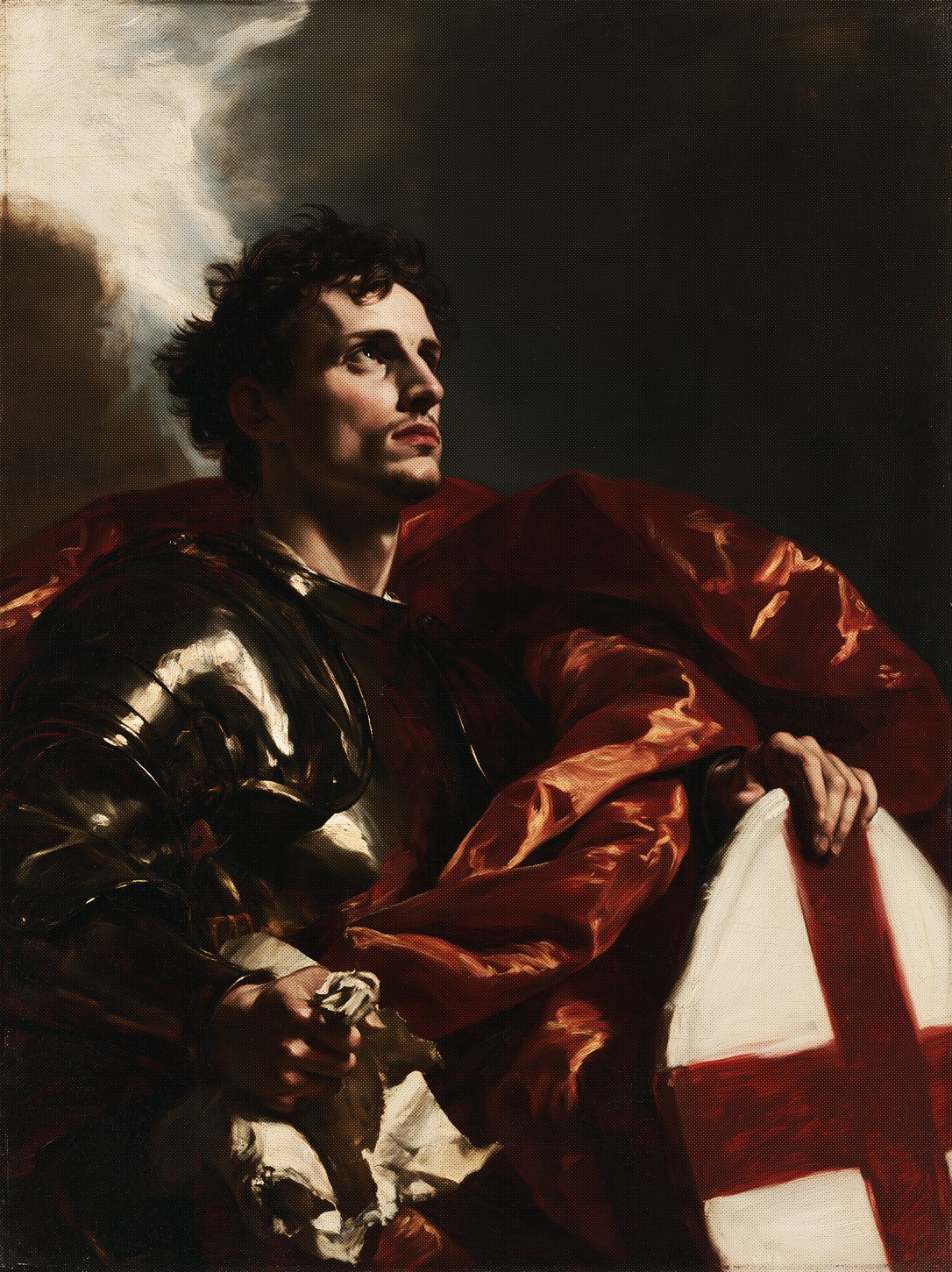
Saint George
- Born
- 3rd century · Cappadocia, Anatolia (Turkey)
- Died
- 23 April 303 · Lydda (Lod), Palestine (Israel)
- Feast day
- 23 April
- Canonized
- Pre-Congregation
Patron of
- England
- Georgia
- Malta
- Portugal
- Catalonia
- Genoa
- Ferrara
- Ljubljana
- soldiers
- cavalry
- scouts
- lepers
Very little about George is certain. The oldest account of his life, the Passion of George, was listed among the apocryphal works in the Decretum Gelasianum of 496, and later versions only add more elaboration. The Passion was translated from Greek into Latin, Coptic, Armenian, Ethiopic, and Arabic for use in the liturgy. From it historians can draw only a few plausible points: he belonged to the military, and he was put to death for declaring himself a Christian. His tomb at Lydda, now Lod in Israel, was honored at least from the fourth century, and the Roman Martyrology speaks of his glorious contest at Diospolis, or Lydda, celebrated by all the churches from East to West since antiquity.
The account tells the rest of his story, which cannot be verified. George was born in Cappadocia to a Persian father, Gerontius, and a Cappadocian mother, Polychronia, who raised him as a Christian. As an adult he became a tribune in the army of an emperor, named Dacian of Persia in some versions and the Roman emperor Diocletian in others. In 303 Diocletian issued an edict from Nicomedia that began the persecution of Christians across the empire. George gave his goods to the poor and was arrested after tearing down the edict, and before the court he confessed his faith. When he refused to renounce it, he was tortured and thrown into prison. There, the story says, the Lord appeared to him in a vision and foretold seven years of torment, three deaths, and three resurrections.
From this point the imagination of the hagiographers takes over. In their tales George defeats a magician named Athanasius, who converts and is martyred. He is cut in two on a wheel studded with nails and swords, then rises from the dead and converts a military commander and his soldiers. These are legends, not history. The most that can be said is that George was probably a soldier who died for his faith, traditionally on 23 April 303.
The dragon came much later. A late legend, made famous in the Middle Ages, shows him as a knight facing a dragon, a picture of faith that triumphs over the power of evil. Since the Crusades he has been honored above all as a military saint, and he is counted among the Fourteen Holy Helpers. England, Georgia, Portugal, Malta, and Catalonia, and the cities of Genoa and Ferrara, have taken him as patron, and countless churches bear his name.
Saint George, pray for us.
Media

Divine Mercy

Catholic Online

The Rest Is History
Art
Saint George and the Princess
Aragonese school · 1459
Public domainSaint George
Andrea Mantegna · 1460
Photo by Didier Descouens · Public domainSaint George and the Dragon
Paolo Uccello · 1470
Public domainSaint George and the Dragon, Storkyrkan
Bernt Notke · 1489
Photo by Jürgen Howaldt · CC BY-SA 2.0 DESaint George and the Dragon
Raphael · 1500
Public domainSaint George and the Dragon
Gustave Moreau · 1880
Public domain