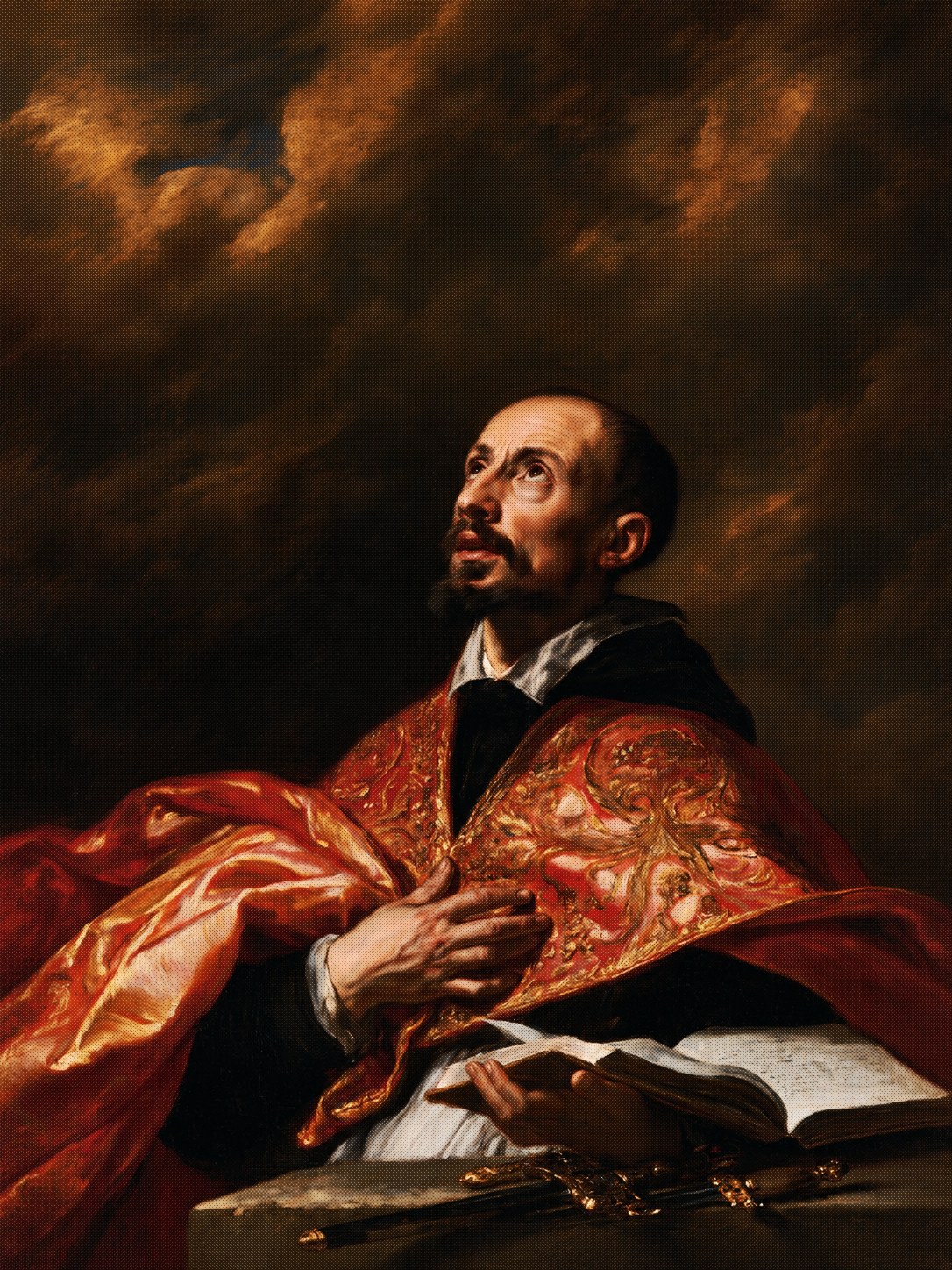
Saint Ignatius of Loyola
- Born
- 1491 · Azpeitia, Gipuzkoa, Spain
- Died
- 31 July 1556 · Rome, Italy
- Feast day
- 31 July
- Canonized
- 12 March 1622 · Pope Gregory XV
Patron of
- Society of Jesus
- soldiers
- spiritual retreats
- Biscay
- Gipuzkoa
- Álava
- Azpeitia
- a good death
- protection against scruples
- protection against wolves
Íñigo López de Loyola was born in 1491 in the family castle near Azpeitia in the Basque country, the youngest of thirteen children of a house of minor nobility. As a younger son he might have been meant for the Church, but he dreamed of becoming a knight. His father sent him to Castile, to the household of Juan Velázquez de Cuéllar, a minister of King Ferdinand the Catholic. Court life shaped his manners and his tastes, and he read poems and courted ladies. After Juan's death he joined the household of Antonio Manrique, duke of Nájera and viceroy of Navarre.
On 20 May 1521 Íñigo was helping to defend the castle of Pamplona against a French siege when a cannonball struck him and left him lame for the rest of his life. During the long recovery he read the Golden Legend and a life of Christ, and the books moved a man who had given himself to knightly ideals toward a new conclusion: the only lord worth following was Jesus Christ.
He set out for the Holy Land. At the shrine of Montserrat he made a vow of chastity and traded his fine clothes for a beggar's. Plague in Barcelona, where he had meant to take ship for Italy, kept him instead at Manresa for more than a year, a time of prayer, penance, and solitude. There, by the river Cardoner, he came to feel that he should found a company of consecrated men, and in a cave he began writing the meditations and rules that were later reworked into the Spiritual Exercises. He did reach Jerusalem and wanted to stay, but the Franciscan superior would not allow it, judging his learning too slight. Íñigo returned to Europe and studied grammar, philosophy, and theology, first at Salamanca and then in Paris.
In Paris he changed his name to Ignatius, in honor of Ignatius of Antioch, whose love for Christ and obedience to the Church he admired. There he gathered his first companions. On 27 September 1540 Pope Paul III approved the Society of Jesus, which was devoted to mission and teaching. Besides the usual vows of poverty, chastity, and obedience, its members took a fourth vow of obedience to the pope in matters of mission, and Ignatius became the first Superior General. As a former soldier, he gave great care to the spiritual formation of new recruits and set down his method in the Spiritual Exercises, published in 1548.
He died in Rome on 31 July 1556, and his tomb is in the Church of the Gesù. Pope Paul V beatified him in 1609, and Pope Gregory XV canonized him on 12 March 1622. In 1922 Pope Pius XI named him patron of all spiritual retreats. He is remembered as the founder of the Jesuits and as the teacher of a way of prayer that is still practiced around the world.
Saint Ignatius of Loyola, pray for us.
Media

Jesuits in Britain

Catholic Online

Jesuits in Britain

ROME REPORTS in English
Art
Portrait of Saint Ignatius of Loyola
Jacopino del Conte · 1556
Public domainSaint Ignatius of Loyola
Juan Martínez Montañés · 1610
Photo by Jl FilpoC · CC BY 3.0Miracle of Saint Ignatius of Loyola
Peter Paul Rubens · 1618
Public domainSaint Ignatius of Loyola
Peter Paul Rubens · 1620
Public domainSaint Ignatius of Loyola
Anthony van Dyck, Gerard Seghers and Jan Wildens · 1630
Public domainThe Conversion of Saint Ignatius of Loyola
Miguel Cabrera
Public domain