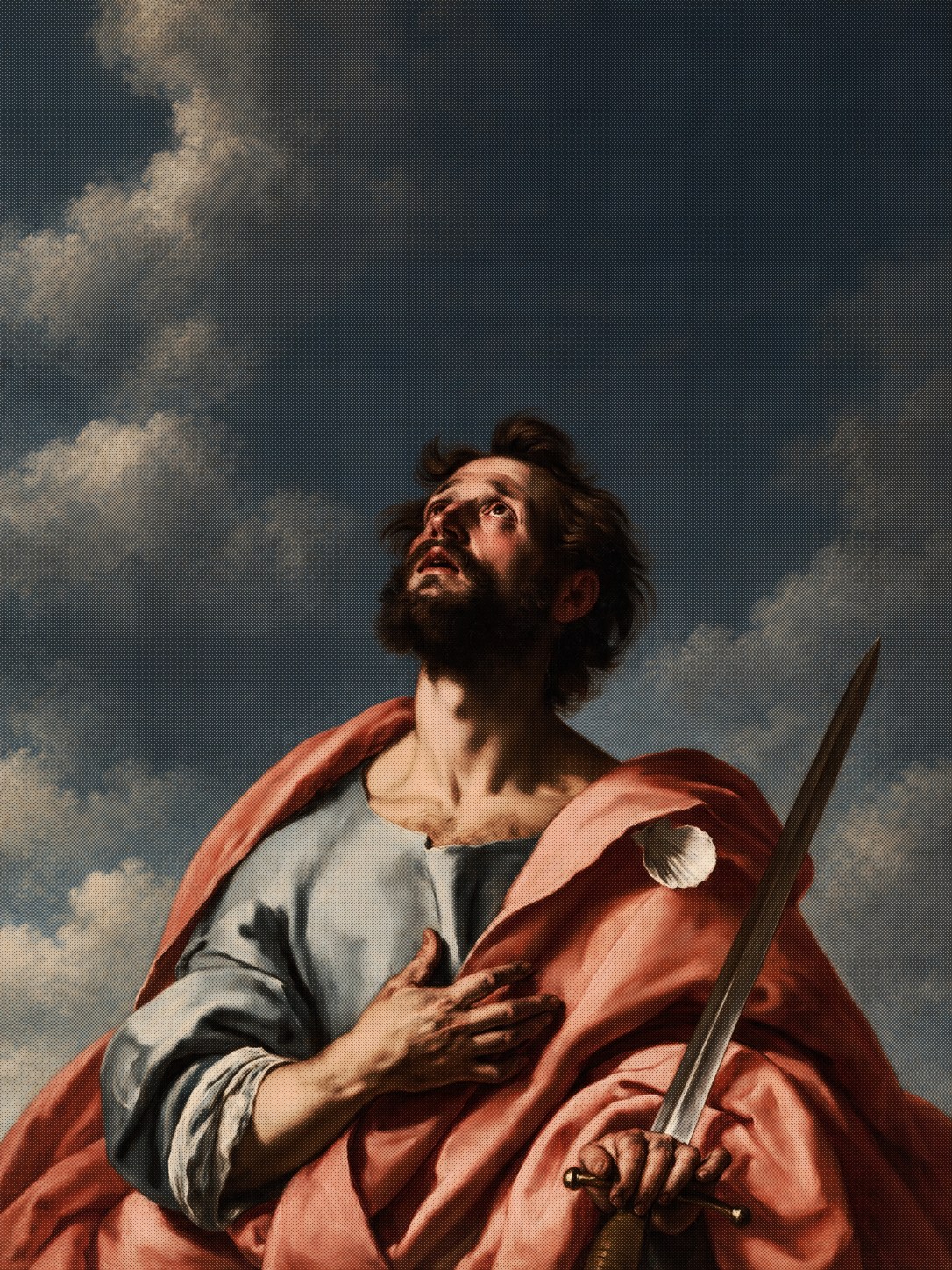
Saint James the Great
- Born
- 1st century · Bethsaida, Galilee
- Died
- c. 44 · Jerusalem
- Feast day
- 25 July
- Canonized
- Pre-Congregation
Patron of
- Spain
- Guatemala
- Nicaragua
- pilgrims
- travelers
- knights
- cavalry of the Spanish Army
- hatmakers
- perfumers
- people with rheumatism
- blessing and protection of harvests
- Pistoia
James and his brother John were the sons of Zebedee, a fisherman of Bethsaida on the Sea of Galilee, and they worked in the family boat. One day, as the brothers sat mending nets with their father, Jesus passed by and called them. The Gospel of Matthew says they left the boat and their father at once and followed him. Jesus gave the two the name Boanerges, the Sons of Thunder, a nickname that fits the impetuous temperament they are shown to have shared.
James became one of the Twelve, and with Peter and John he formed an inner circle. These three alone were with Jesus when he raised the daughter of Jairus, on the mountain of the Transfiguration, when his face shone like the sun, and in the garden of Gethsemane, where fear and anguish came over him. The Gospels do not hide James's rough edges. He and his brother, or in Matthew's telling their mother Salome on their behalf, asked Jesus for the places of honor in his kingdom. When Jesus asked whether they could drink the cup he was about to drink, they answered that they could, and the other apostles were annoyed. On another occasion the brothers wanted to call down fire on a Samaritan town, and Jesus rebuked them.
The question about the cup proved prophetic. The Acts of the Apostles records that King Herod, usually identified as Herod Agrippa, began to persecute members of the church and had James killed with the sword. This was in Jerusalem, around the year 44, and it made James the first of the Twelve to die as a martyr.
Later tradition carried his story to Spain. The Golden Legend, written in the thirteenth century, says that after his beheading his body was taken there. According to tradition, in the ninth century a strange light led to the discovery of a tomb inscribed with the words "Here lies Jacobus, son of Zebedee and Salome." The place became known as the field of the star, a name traditionally linked with Compostela. Work on a great basilica began there in 1075, and since the Middle Ages pilgrims have walked to Santiago de Compostela from all over Europe. The scallop shell and the pilgrim's hat became his emblems.
James is remembered as the first apostle to give his life for Jesus, and as the patron of Spain and of those who travel the roads to his shrine.
Saint James the Great, pray for us.
Media

Divine Mercy

Augustine Institute

Catholic Online

EWTN
Art
Saint James the Elder
Niccolò di Piero Lamberti · c. 1420
Photo by Sailko · CC BY-SA 3.0Cardinal of Portugal's Altarpiece
Antonio and Piero del Pollaiuolo · 1467
Public domainThe Apparition of the Virgin to Saint James the Great
Nicolas Poussin · 1629
Public domainThe Archangel Raphael with Saints James the Great and Nicholas
Cima da Conegliano
Public domain