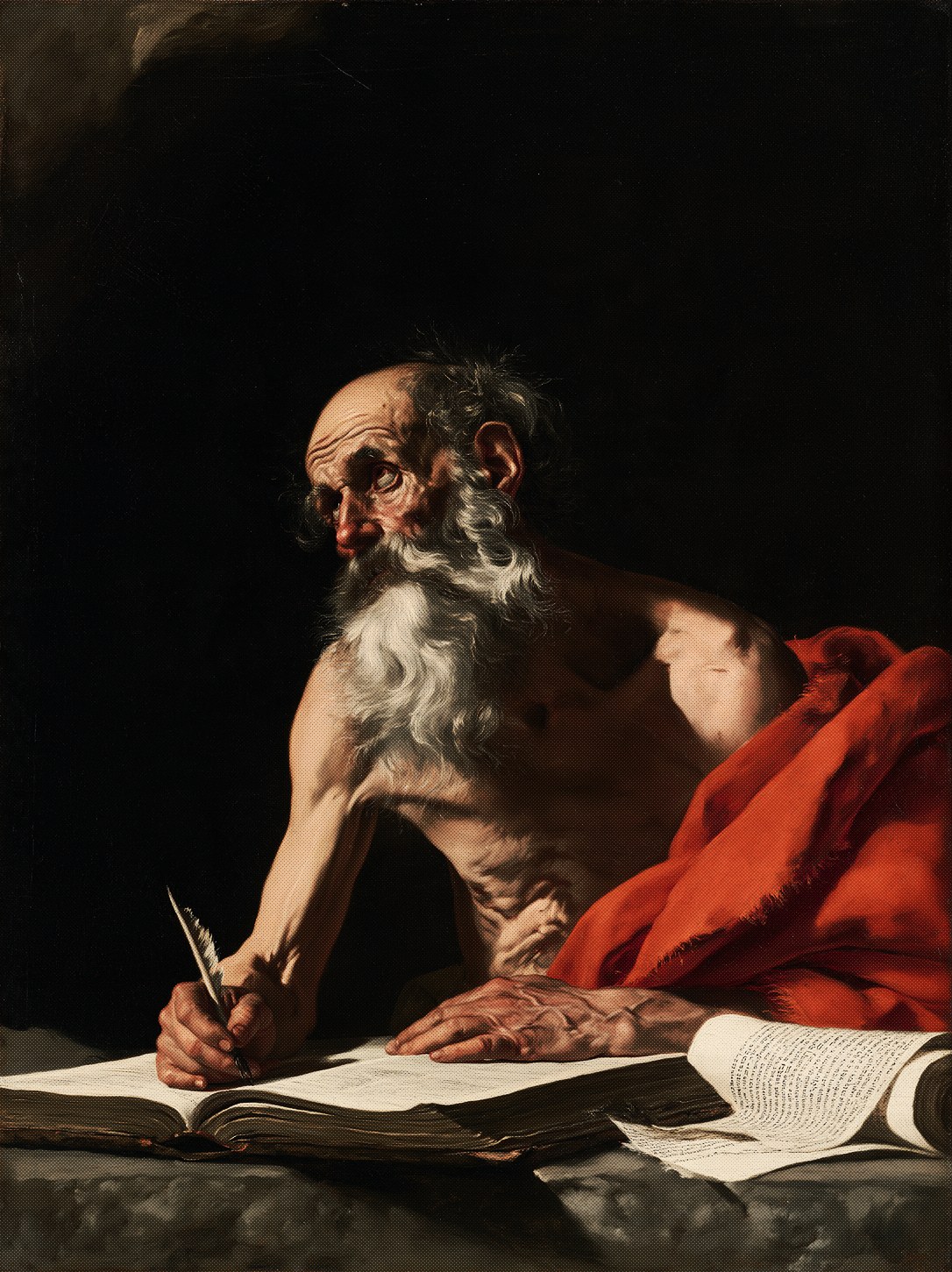
Saint Jerome
- Born
- c. 347 · Stridon, on the border of Dalmatia and Pannonia
- Died
- 30 September 420 · Bethlehem, Palestine
- Feast day
- 30 September
- Canonized
- Pre-Congregation
Patron of
- translators
- librarians
- libraries
- students
- school children
- archaeologists
- archivists
- Bible scholars
- booksellers
- the nearsighted
- Catholic humanists
- Dalmatia
Jerome's name is attached to some of the most important books of Latin Christianity, yet he came to them by a long road. He was born around 347 at Stridon, a town on the border between Dalmatia and Pannonia whose exact site is still debated. His family was Christian and well off, and while still young he was sent to Rome to study grammar and rhetoric, among others under the famous grammarian Aelius Donatus. The classical education he received there stayed with him for life. He knew Latin literature deeply and also read Greek.
He was baptized in Rome, probably in the later 360s. As a student he lived as many students did and was tormented by guilt afterward. He then lived at Trier and at Aquileia, where he joined a circle of scholars and ascetics around Bishop Valerian. Rufinus of Aquileia was among his friends there, and the two would later fall into a long and bitter quarrel.
In 373 he left the West for the East. After crossing Asia Minor he reached Antioch, where he met leading theologians and deepened his study of biblical interpretation. A serious illness pushed him toward a stricter ascetic life, and he withdrew into the desert of Chalcis, southwest of Antioch. There he spent several years in prayer and study and learned the languages he needed to read the Bible. He was ordained a priest at Antioch, spent time in Constantinople, and returned to Rome in 382.
In Rome he joined the circle of Pope Damasus I and served as his secretary. Damasus asked him to revise the Latin versions of the Bible, and that work led to his celebrated translations, the version later known as the Vulgate. For the Old Testament Jerome tried to work from the Hebrew text rather than from the Greek Septuagint, as earlier Latin translators had. From 386 he lived at Bethlehem, where he worked as translator, commentator, writer, and spiritual guide and exchanged letters with many leading churchmen of his time. His commentaries cover the whole Bible, and he also wrote polemical and historical works. He gave special attention to the lives of women who wished to live devoted to Christ, and several wealthy Roman women of senatorial families were among his supporters.
He died at Bethlehem on 30 September 420, an old man. With Ambrose, Augustine, and Gregory the Great he is counted among the four great Latin Fathers of the Church, and he is a Doctor of the Church. He is remembered above all for putting the Scriptures into the Latin that the Western Church would use for centuries.
Saint Jerome, pray for us.
Media
Divine Mercy

Augustine Institute

Catholic Online

EWTN Great Britain
Art
Saint Jerome in the Desert
Andrea Mantegna · c. 1449
Public domainSaint Jerome in His Study
Antonello da Messina · 1474
Public domainSaint Jerome in His Study
Domenico Ghirlandaio · 1480
Photo by Sailko · CC BY 3.0Saint Jerome in the Wilderness
Leonardo da Vinci · c. 1480
CC0Saint Jerome in His Study
Albrecht Dürer · 1514
CC0Saint Jerome Writing
Caravaggio · 1607
Public domain