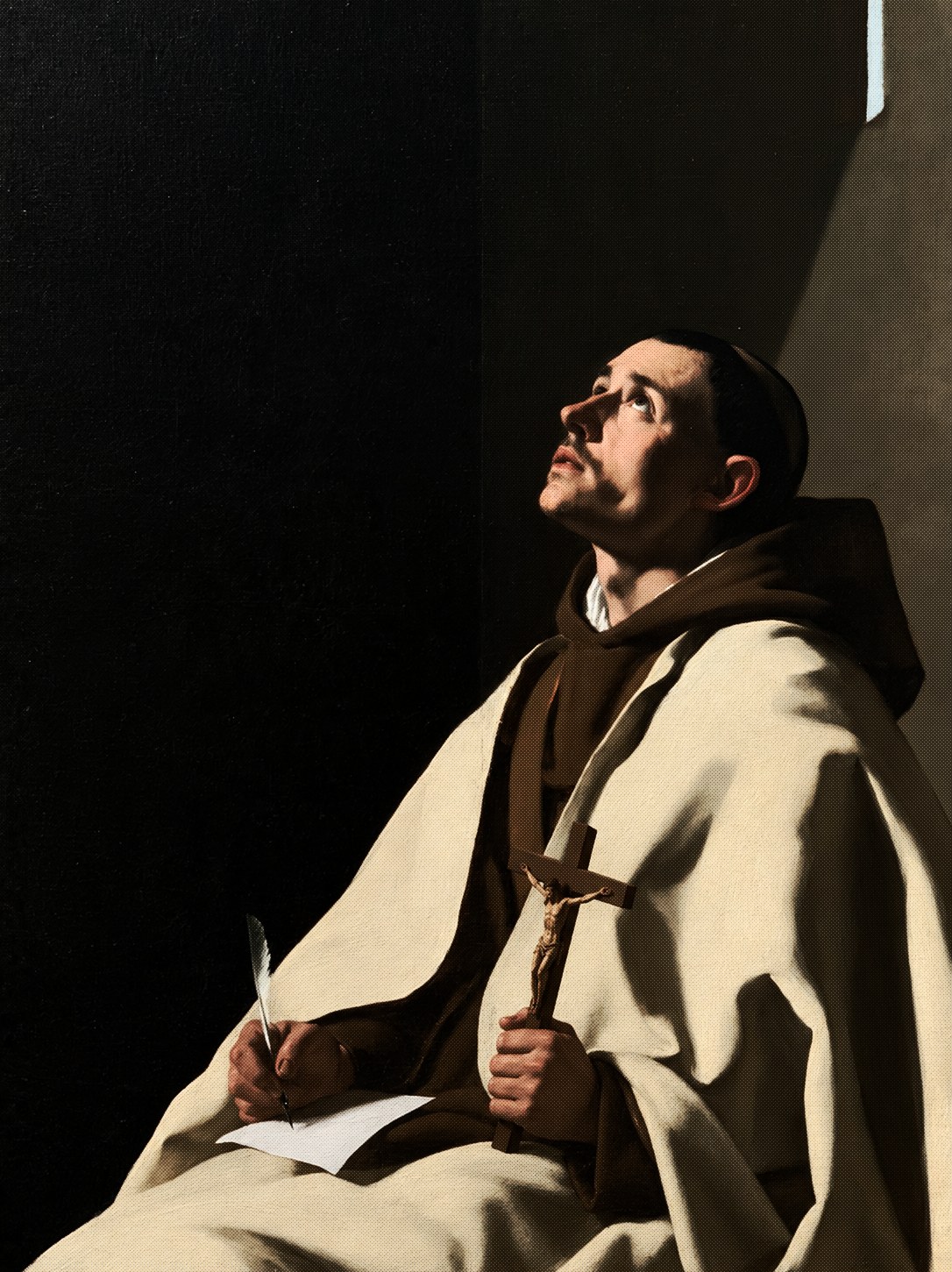
Saint John of the Cross
- Born
- 24 June 1542 · Fontiveros, Ávila, Spain
- Died
- 14 December 1591 · Úbeda, Spain
- Feast day
- 14 December
- Canonized
- 27 December 1726 · Pope Benedict XIII
Patron of
- Spanish poets
- mystics
- contemplatives
On his deathbed, John of the Cross asked for something less solemn than the prayers for the dying that his brothers were reading. He asked instead for verses from the Song of Songs, the Old Testament love poem he knew so well, because he believed he was going to meet Love. After the reading he died praying, "Into your hands, Lord, I commend my spirit." It was 14 December 1591 in Úbeda, and he was forty-nine.
He was born Juan de Yepes y Álvarez on 24 June 1542 at Fontiveros, near Ávila, in a family rich in love and poor in money. His father, Gonzalo, came from a family of silk merchants in Toledo and worked as an accountant for wealthier relatives. In 1529 he married Catalina, a poor orphan, and his family rejected him for it. He had to work as a weaver beside his wife. He died in 1545, when John was about three, and John's older brother Luis died soon after, probably from malnourishment. Catalina moved with John and his surviving brother Francisco to Arévalo and then, in 1551, to Medina del Campo, where she found work.
At Medina, John entered a school for 160 poor children, most of them orphans, where he received a basic education and some food, clothing, and lodging. He served as an altar boy at a nearby convent of Augustinian nuns. As he grew older he worked in a hospital and studied the humanities at a Jesuit school from 1559 to 1563. In 1563 he took the habit of the Carmelites at Medina. He studied philosophy and theology at Salamanca and was ordained a priest in 1567.
That same year he met Teresa of Ávila, who had just won permission to found two houses of contemplative Carmelite men to support the nuns she had established. On 28 November 1568, John joined the first small group of reformed friars at Duruelo and took the name John of the Cross. He held a number of posts in the reform, including confessor and governor of the Convent of the Incarnation at Ávila from 1572 to 1577. In 1577, fellow Carmelites who opposed the reform seized him and held him for months in a cell at Toledo. He composed some of his finest poems there, and eventually he escaped.
His poetry and his writings on the progress of the soul are counted among the summits of Christian mystical literature and of Spanish literature. He described the spiritual life in three ways, the purgative, the illuminative, and the unitive, separated by the dark nights of sense and soul. He had written years before of death as a sweet meeting, and he met it in that spirit.
Pope Clement X beatified him in 1675, and Benedict XIII canonized him on 27 December 1726. In 1926 Pius XI declared him a Doctor of the Church, and he is known as the Mystical Doctor.
Saint John of the Cross, pray for us.
Media

Matt Fradd
EWTN

Bishop Robert Barron

OCDS Washington Province Carmelites
Art
Saint John of the Cross
1656
Public domainChrist Appears to Saint John of the Cross
Domenico Piola · 1675
Photo by Sailko · CC BY 3.0Saint John of the Cross
Francisco Antonio Gijón · 1675
Photo by Alvesgaspar · CC BY-SA 4.0Ceramic Panel of Saint John of the Cross, Valencia
1942
Photo by 19Tarrestnom65 · CC BY-SA 4.0The Virgin of Carmel with Saint Teresa and Saint John of the Cross
Juan Rodríguez Juárez
Public domain