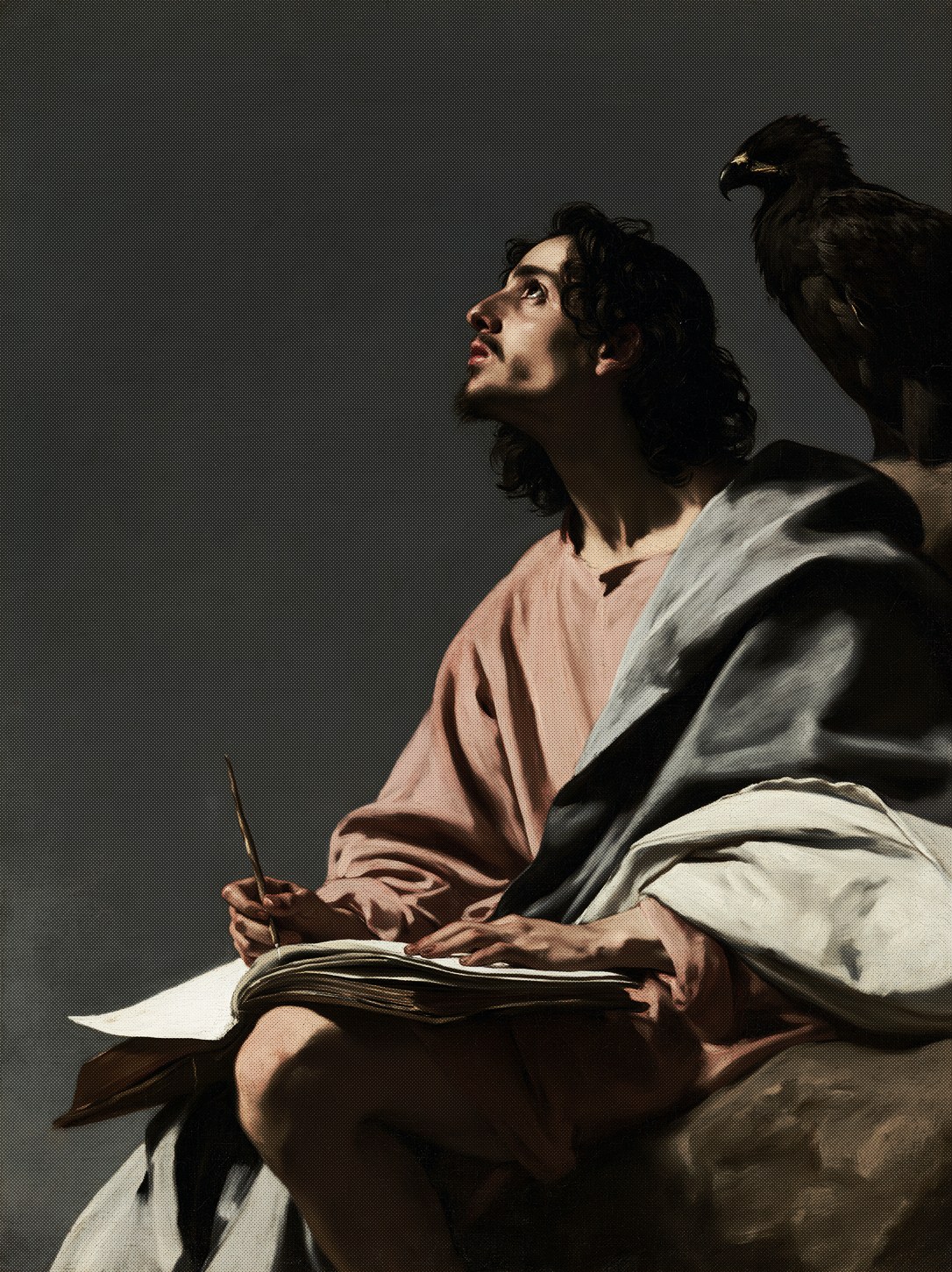
Saint John the Apostle
- Born
- c. AD 6 · Bethsaida, Galilee
- Died
- c. AD 100 · Ephesus (Selçuk, Turkey)
- Feast day
- 27 December
- Canonized
- Pre-Congregation
Patron of
- theologians
- Catholic writers
- booksellers
- printers
- artists
- friendships
- widows
- Asia Minor
- Ephesus
- Patmos
- Sansepolcro
- protection against poison
John was a fisherman from Galilee, a son of Zebedee and the younger brother of James. According to church tradition, his mother was Salome. The family worked on the Sea of Galilee, and John was mending nets with James and with Simon and Andrew when Jesus called them to follow him. Jesus gave the two brothers the nickname "Sons of Thunder" for their fiery temper. Tradition holds that John was the youngest of the Twelve.
He belonged to the small circle closest to Jesus, with Peter and James, and was with them at the Transfiguration and during the Passion. The Beloved Disciple of the fourth Gospel, whom tradition identifies as John, reclines beside Jesus at the Last Supper. When Jesus was crucified, John stood at the foot of the cross beside Mary, and Jesus entrusted his mother to him as his own. After the resurrection, it is John who is first to recognize the risen Lord when he appears on the shore of the Sea of Galilee. In the early days of the Church he is found at Peter's side.
Church tradition identifies him with John the Evangelist, author of the fourth Gospel, and with the John who wrote the Book of Revelation on the island of Patmos, and many attribute to him three letters as well. The Church Fathers claimed that he outlived the other apostles and was the only one to die a natural death, probably at Ephesus around the year 100, at an advanced age. Modern scholars are divided on all of this, and many conclude that he wrote none of the works traditionally credited to him, though others still defend the traditional view.
Later legends add vivid details. One says that he was plunged into a cauldron of boiling oil and came out unharmed, and another that he drank a poisoned cup without harm, which is why artists show him with a cup and a cauldron, along with the eagle that came to stand for the lofty theology of his Gospel. The Church honors him as a theologian who was found worthy to contemplate the glory of the incarnate Word and who proclaimed what he had seen with his own eyes. He is remembered above all as the disciple closest to Jesus, and he is invoked as a patron of writers, theologians, and booksellers.
Saint John the Apostle, pray for us.
Media

Augustine Institute

Catholic Online

EWTN
Art
Saint John on Patmos
Hieronymus Bosch · 1489
Public domainCrucifixion with the Virgin Mary, Saint John and Saint Mary Magdalene
Anthony van Dyck · 1618
Public domainThe Four Apostles
Albrecht Dürer · 1526
Public domain