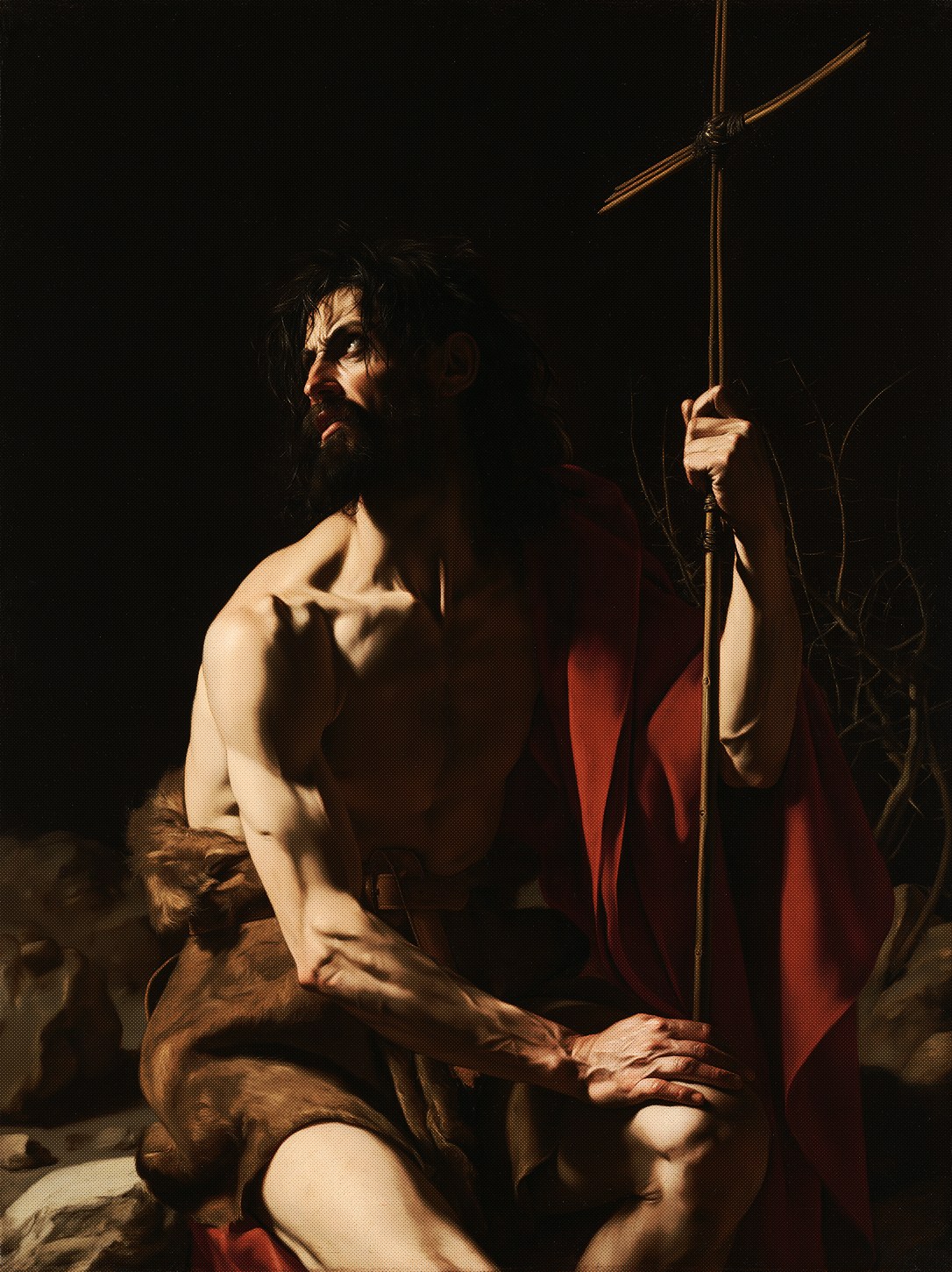
Saint John the Baptist
- Born
- c. 6 BC · Ein Karem, Judea
- Died
- c. AD 30 · Machaerus, Jordan
- Feast day
- 24 June (Nativity) · 29 August (Passion)
- Canonized
- Pre-Congregation
Patron of
- Florence
- French Canadians
- Albacete
- Badajoz
- baptisteries
- innkeepers
- singers
- prisoners
- people condemned to death
- tanners
- wool carders
- people with migraine
John the Baptist holds a place in the Church's calendar that almost no other saint shares. Most saints are remembered on the day of their death, which the Church treats as their birth into heaven. John is also remembered on the day he was born, 24 June, a feast sometimes called the summer Christmas. Only Jesus and Mary are honored this way besides him. The date follows the timing in Luke's Gospel, which puts his birth about three months after the Annunciation and six months before Christmas.
Luke tells of his beginnings. John was the son of Zechariah and Elizabeth, and the angel Gabriel announced his coming to Zechariah. Even before he was born, Luke says, he leapt in Elizabeth's womb when Mary, carrying Jesus, came to visit. Luke also describes John and Jesus as relatives.
Of his adult life, the Gospels show a man of severe simplicity. He lived in the desert, wore a garment of camel's hair, and ate locusts and wild honey. He preached along the Jordan River, calling people to repentance and baptizing them as a sign of it, and he told them that someone greater than himself was coming. Most biblical scholars agree that he baptized Jesus, and several New Testament accounts report that some of Jesus's earliest followers had first followed John. The Gospels portray him as the forerunner of Jesus. Jesus spoke of him as the Elijah who was to come, and said that no one born of woman was greater.
His preaching cost him his life. According to the New Testament, John rebuked Herod Antipas for divorcing his wife and marrying Herodias, who had been the wife of Antipas's brother Herod Philip I. Antipas held John in prison at the fortress of Machaerus, in what is now Jordan. On his birthday, at the request of Herodias's daughter, he ordered John beheaded, around AD 30. The historian Josephus also records that Antipas had John put to death at Machaerus. The Church remembers his passion on 29 August.
John's influence outlasted him. His followers persisted into the second century, and some proclaimed him the awaited Messiah. Today the Mandaeans regard him as their greatest and final prophet, and Islam honors him as the prophet Yahya. In the Church, his old commemoration is linked to the dedication of a church built at Sebaste, near what was believed to be his tomb. He is remembered as the prophet who stepped aside for the one he announced, and who bore witness to the truth in life and in death.
Saint John the Baptist, pray for us.
Media

Bishop Robert Barron

Divine Mercy
Divine Mercy

Augustine Institute
Art
The Altar of Saint John
Rogier van der Weyden · c. 1455
Public domainSaint John the Baptist in the Wilderness
Hieronymus Bosch · 1489
Public domainSaint John the Baptist
Leonardo da Vinci · 1514
Public domainSaint John the Baptist
Titian · c. 1540
Public domainYoung Saint John the Baptist with a Ram
Caravaggio · 1602
Public domainThe Beheading of Saint John the Baptist
Caravaggio · 1608
Public domain