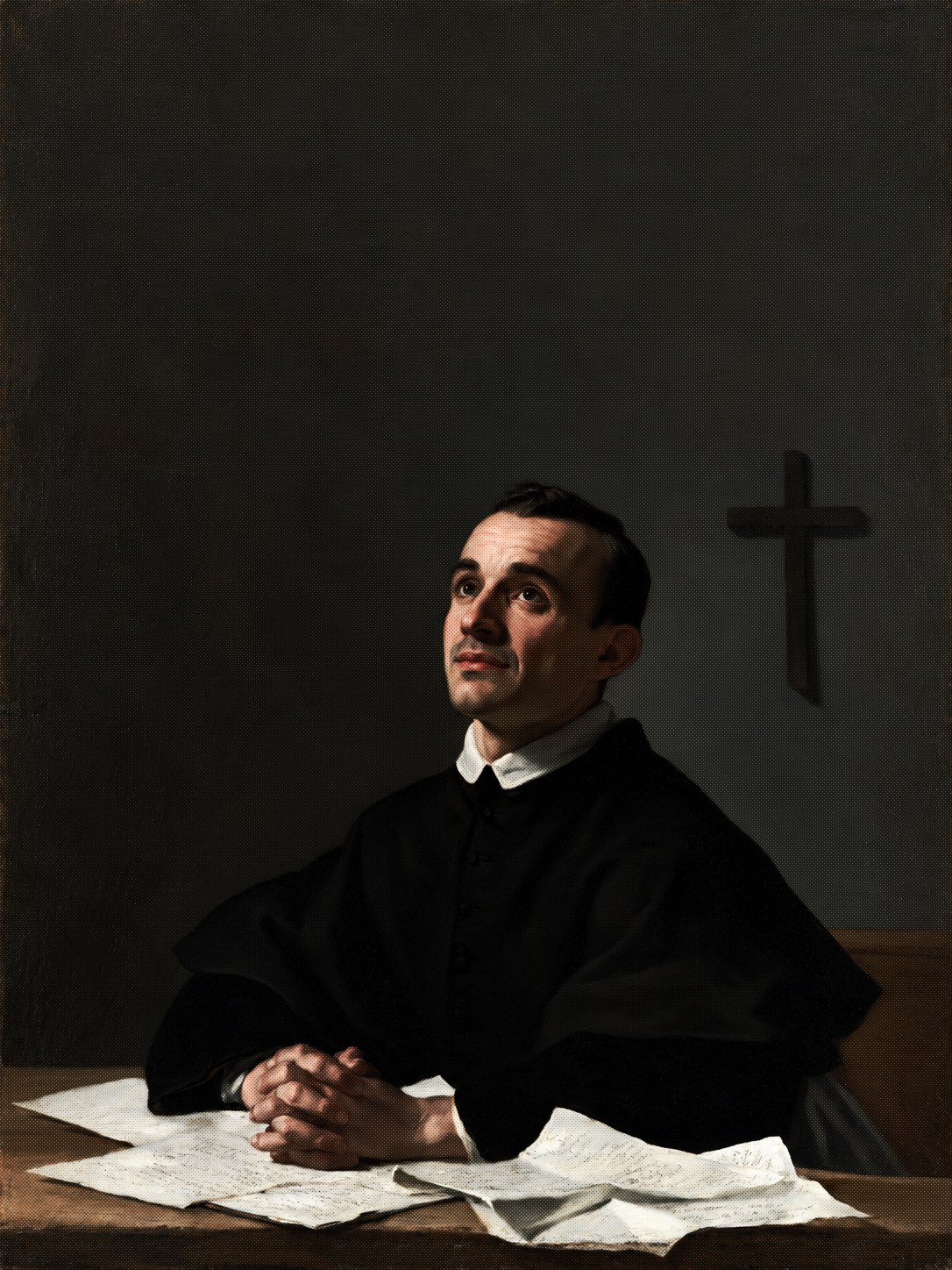
Saint Josemaría Escrivá
- Born
- 9 January 1902 · Barbastro, Aragon, Spain
- Died
- 26 June 1975 · Rome, Italy
- Feast day
- 26 June
- Canonized
- 6 October 2002 · Pope John Paul II
Patron of
- Opus Dei
- people with diabetes
In 1918, in the snow of Logroño, sixteen-year-old Josemaría Escrivá noticed the prints of bare feet left by some Carmelite friars who had come to the city. He asked himself what he could offer to Jesus in return for such complete generosity. He had been born on 9 January 1902 in Barbastro, in Aragon, the second of six children, and his family had moved to Logroño. Now he sensed that God was looking for something from him, though it had no shape yet.
He decided that becoming a priest was the best way to be ready. He studied in Logroño and then at the seminary in Zaragoza, and he also studied law, following the advice of his father, who died in 1924. Josemaría was ordained on 28 March 1925, and his first assignment was a poor district on the edge of Zaragoza, among people who were poor and unable to read. In 1927 he moved to Madrid, where he pursued a doctorate in civil law at the Central University, gave private lessons to earn money for his family, and worked among the poor and the sick in the slums and the hospitals.
On Wednesday, 2 October 1928, after Mass, he went up to his room and began sorting through his notes. There, he said, he saw the work God was asking of him: people of every nation, age, and culture who would seek God and find him in ordinary life, making holy their work, whether humble or prestigious, and bringing Christian spirit to their surroundings. He knelt. He later said that he had been twenty-six years old with God's grace and good humor and nothing else. He founded Opus Dei, an organization of lay people and priests devoted to everyday holiness.
The Spanish Civil War, which struck the Church with particular ferocity, forced him into hiding in 1936. He fled Madrid by way of Andorra and France to Burgos. After the war he returned to Madrid and completed his doctorate in 1939. His best-known book, The Way, has been translated into 43 languages. He settled in Rome in 1946 and received a doctorate in theology from the Lateran University in 1955, while Opus Dei spread to many countries.
Josemaría Escrivá died in Rome on 26 June 1975. Pope John Paul II beatified him on 17 May 1992 and canonized him on 6 October 2002. Admirers remember him for teaching that holiness is open to people in every walk of life. Opus Dei and its founder have also drawn controversy and criticism, and his canonization was widely debated.
Saint Josemaría Escrivá, pray for us.
Media

Prelature of Opus Dei

EWTN