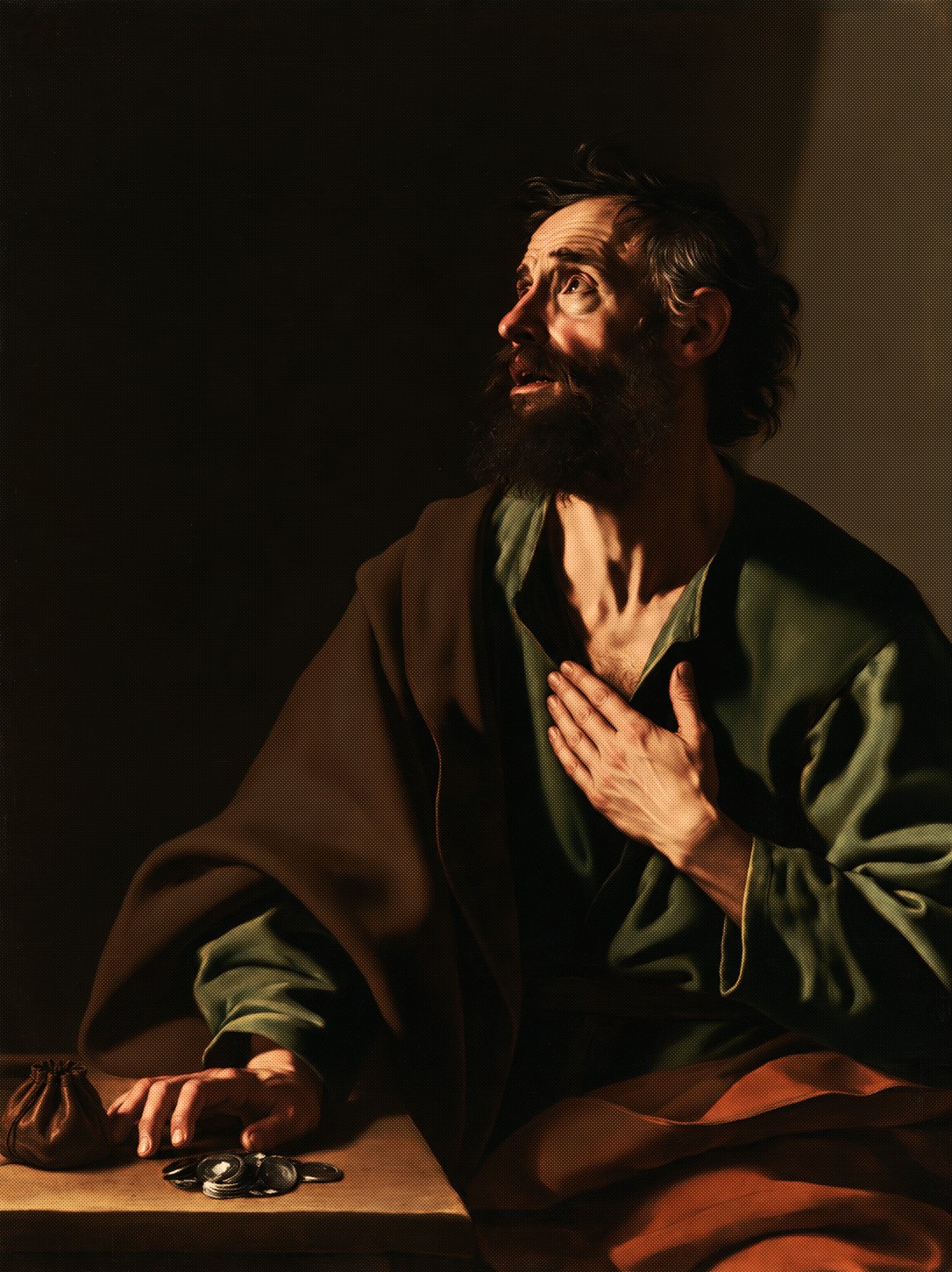
Saint Matthew the Apostle
- Born
- 1st century · Capernaum, Galilee
- Died
- 1st century · Ethiopia or Persia (according to tradition)
- Feast day
- 21 September
- Canonized
- Pre-Congregation
Patron of
- accountants
- bankers
- tax collectors
- customs officers
- civil servants
- perfumers
- money changers
- Italian financial police
- Salerno
- Diocese of Salerno-Campagna-Acerno
- Osorno, Chile
- Asiago
Matthew was a tax collector at Capernaum, in Galilee, when Jesus called him. According to the Gospels, Jesus passed by and found him at the tax booth and said simply, "Follow me." Matthew got up and followed, and at once he gave a banquet at which Jesus sat with a crowd of tax collectors and others thought to be sinners. In the Gospels of Mark and Luke, the man called is named Levi, the son of Alphaeus, while the same scene in Matthew's own Gospel names him Matthew. The two are generally taken to be the same person. Some suppose that he took a new name to mark a change of life, as Simon became Peter and Saul became Paul. Matthew means "gift of God."
As a tax collector he was a man of some education, and since he seems to have had a Greek formation, he may have Hellenized his Hebrew name. His role in passing on the Gospel was of great importance. After the resurrection, early Christians had begun to gather episodes from the life of the Lord and to arrange his sayings around key words, and these served them as a fulfillment of the Old Testament readings they still heard in the synagogues. Drawing on such early collections, Matthew is said to have written, in Aramaic, a broad account of the words and deeds of Jesus, stressing that he was the Messiah and showing where the Church stood in relation to the law and worship of the old covenant. The Gospel is aimed above all at Jewish Christians and ties the teachings of Jesus constantly to the Old Testament. Translated into Greek, it became a tool for preaching and liturgy. It contains the complete Sermon on the Mount and the Beatitudes.
Matthew is listed among the Twelve, and the Acts of the Apostles places him in the upper room in Jerusalem after the Ascension, at the choice of Matthias and at Pentecost. Church Fathers such as Irenaeus and Clement of Alexandria say that he preached to the Jewish community in Judea before going to other countries. Ancient writers do not agree on which countries, but almost all name Ethiopia, which is more likely the region south of the Caspian Sea than the modern African nation. The Catholic Church and the Orthodox Church both hold the tradition that he died as a martyr, though no reliable account of his death survives. He is honored as a patron of those who work with money and taxes, among others, and is the patron of the city of Salerno.
Saint Matthew the Apostle, pray for us.
Media

Divine Mercy

Catholic Online

St. Paul Center

EWTN
Art
Saint Matthew the Apostle
Theodoric of Prague · 1360
Public domainSaint Matthew the Evangelist
Jacopo di Cione · 1400
Public domainThe Martyrdom of Saint Matthew
Caravaggio · 1600
Public domainSaint Matthew and the Angel
Guido Reni · 1620
Public domainSaint Matthew and the Angel
Rembrandt · 1661
Public domainThe Calling of Saint Matthew
Caravaggio
CC0