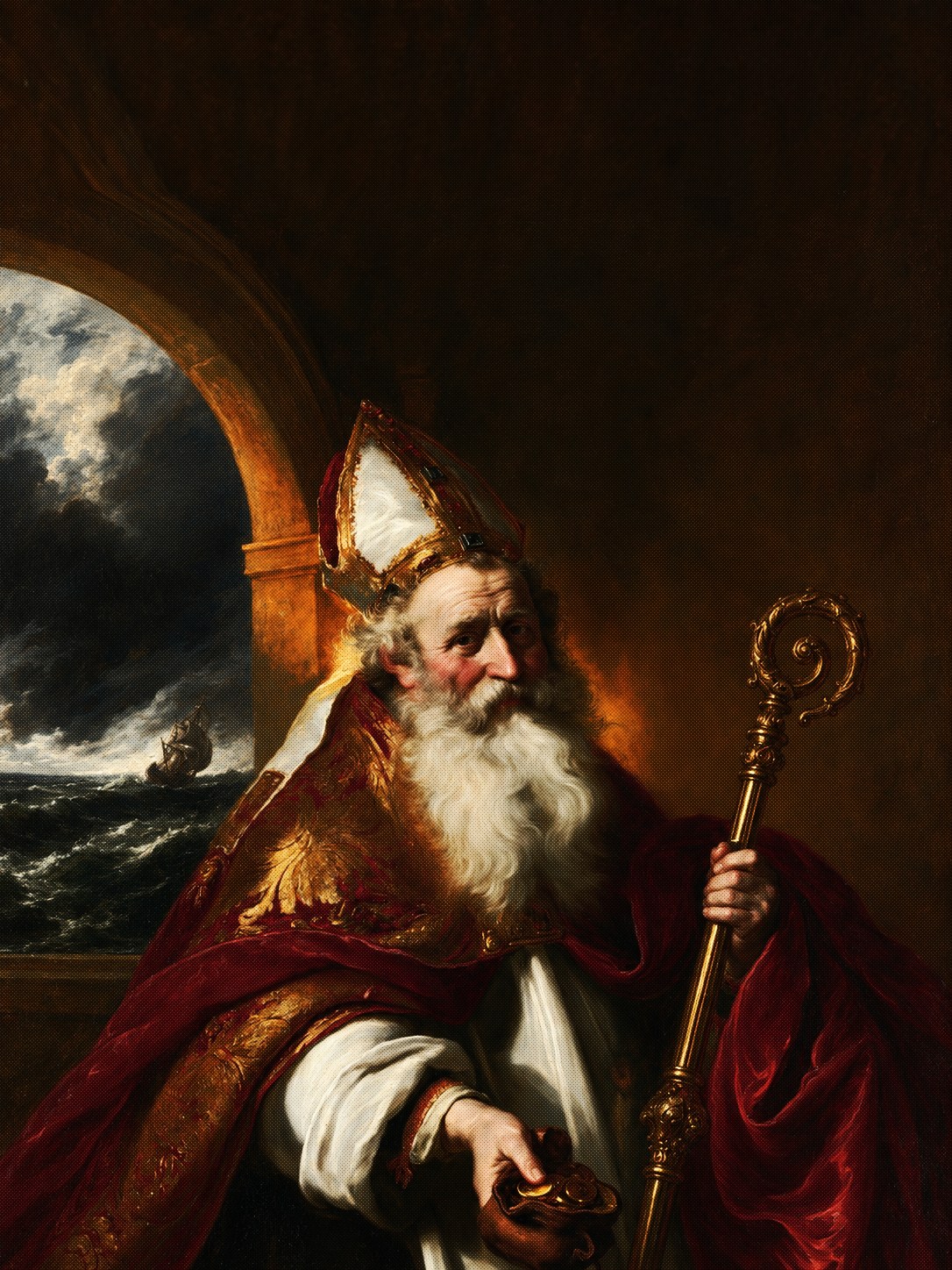
Saint Nicholas of Myra
- Born
- c. 270 · Patara, Lycia (Antalya Province, Turkey)
- Died
- c. 343 · Myra, Lycia (Demre, Turkey)
- Feast day
- 6 December
- Canonized
- Pre-Congregation
Patron of
- children
- sailors
- merchants
- students
- archers
- brewers
- pawnbrokers
- pharmacists
- repentant thieves
- unmarried women
- Bari
- Fribourg, Switzerland
Very little is known for certain about Nicholas of Myra. The earliest accounts of his life were written centuries after his death and carry a good deal of legendary elaboration, so the Nicholas of history is far harder to see than the Nicholas of devotion. According to tradition, he was born in the seaport of Patara in Lycia, on the southern coast of what is now Turkey, to a wealthy Christian family, and he traveled to Egypt and Palestine as a young man. Soon after his return he became bishop of the nearby city of Myra. During the persecution under Diocletian he was imprisoned, and he was freed when Constantine came to power. An early list places him at the Council of Nicaea in 325, but none of the people who attended mention him, and the later tale that he slapped the heretic Arius there is a late legend.
The stories that made him beloved are about generosity. The best known says that a poor father could not afford dowries for his three daughters and was close to losing them to a life of shame. Nicholas, the story goes, dropped a sack of gold coins through the window of their house on three successive nights, so that each daughter could marry. Other tales have him calming a storm at sea, rescuing three innocent soldiers from execution, and, in a much later legend, restoring to life three children murdered by a butcher during a famine. These stories help explain why he came to be invoked by sailors, by young women hoping to marry, by people who had been wronged, and above all by children.
Within two centuries of his death a church was built at Myra under Emperor Theodosius II. In 1087 his relics were carried to Bari in southern Italy, where he is the city's patron and is seen as a bridge between the Christian East and West. His legendary habit of giving in secret later fed the folklore of Santa Claus, by way of the Dutch Sinterklaas.
Saint Nicholas of Myra, pray for us.
Media

Ascension Presents

EWTN News

Catholic Online
Art
The Charity of Saint Nicholas of Bari
Ambrogio Lorenzetti · 1330
Photo by Sailko · CC BY-SA 3.0Stories of Saint Nicholas
Fra Angelico · 1437
Public domainSaint Nicholas of Bari
Carlo Crivelli · 1472
Public domainSaint Nicholas in Glory
Lorenzo Lotto · 1527
Public domainSaint Nicholas of Myra Saves Three Innocents from Death
Ilya Repin · 1888
Public domainStatue of Saint Nicholas, Bari
Zurab Tsereteli
Photo by Berthold Werner · CC BY-SA 3.0