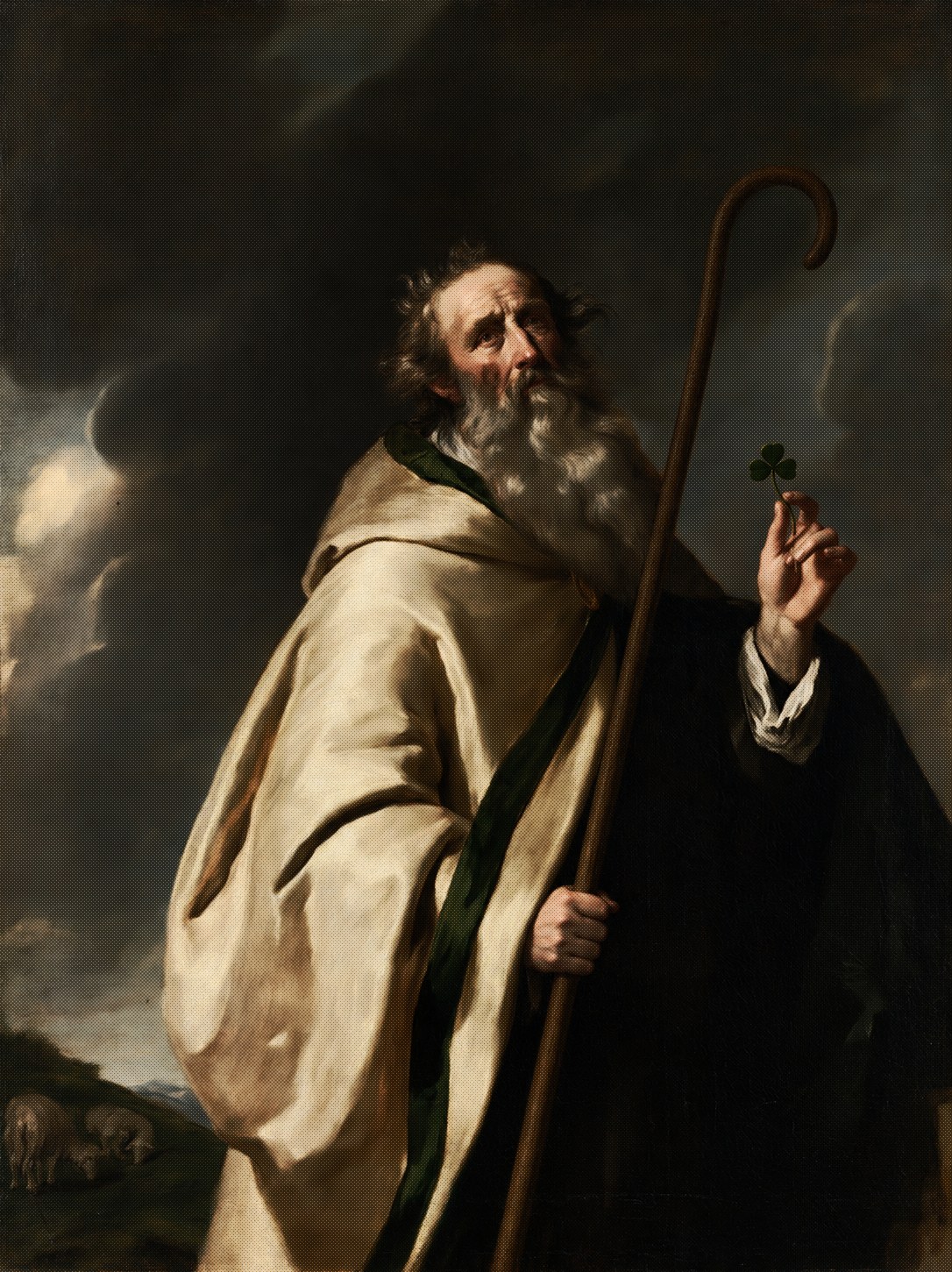
Saint Patrick
- Born
- c. 385 · Roman Britain
- Died
- c. 461 · Saul, County Down, Ireland
- Feast day
- 17 March
- Canonized
- Pre-Congregation
Patron of
- Ireland
- Nigeria
- Montserrat
- Archdiocese of New York
- Boston
- Murcia, Spain
- Archdiocese of Melbourne
- miners
- engineers
- paralegals
- protection against rabies
- Diocese of Macerata-Tolentino-Recanati-Cingoli-Treia
Patrick was about sixteen when Irish raiders seized him from his family's estate in Roman Britain. He had been born around 385 into a Christian household, and his childhood had been settled and comfortable. His father, Calpurnius, was a deacon, and the family owned land near their town. The raiders carried Patrick across the sea and sold him into slavery in Ireland.
For six years he tended his master's flocks, far from home among people whose language he did not understand. He later wrote that the loneliness drove him to prayer. He prayed many times a day and nearly as often at night, and his faith deepened. As he learned the language and the customs of the Irish, he came to see that their tribal society, though pagan, was less crude than he had first thought. After failed attempts to flee, he escaped aboard a ship and, with its crew, landed on a deserted coast of Gaul. The journey inland dragged on until their food ran out. The sailors, who were pagans, urged Patrick to ask his God for help, and soon afterward a herd of pigs appeared and they were fed.
How he found his way home is not recorded, but he returned to his family in Britain. He then studied for many years, probably in Gaul, where he may have first met monastic life. Eventually he went back to Ireland as a bishop. By his own account he baptized thousands of people and ordained many priests. Years later church leaders in Britain summoned him to answer accusations, and he replied with a long, personal statement of defense, which became his Confessio. His only other surviving writing is a letter to the soldiers of Coroticus.
The first lives of Patrick were written in the seventh century by Muirchú and Tírechán, by which time he was revered as Ireland's patron. Tradition makes him the first bishop of Armagh and credits him with bringing Christianity to the island, though there were Christians in Ireland before him. Popular legends say that he used the shamrock to explain the Trinity, drove the snakes out of Ireland, and fasted on a mountaintop. The date of his death cannot be fixed, but tradition places it on 17 March, and that day is celebrated in Ireland and wherever the Irish have settled.
Saint Patrick, pray for us.
Media

Ascension Presents

Divine Mercy

Bishop Robert Barron

EWTN Ireland
Art
Saint Patrick Preaching
Jeanne de Montbaston · c. 1325–1350
CC0Saint Patrick and the King
Richard de Montbaston · 1348
CC0Saint Patrick
William Orpen · 1905
Public domainSaint Patrick
Harry Clarke · 1925
CC0