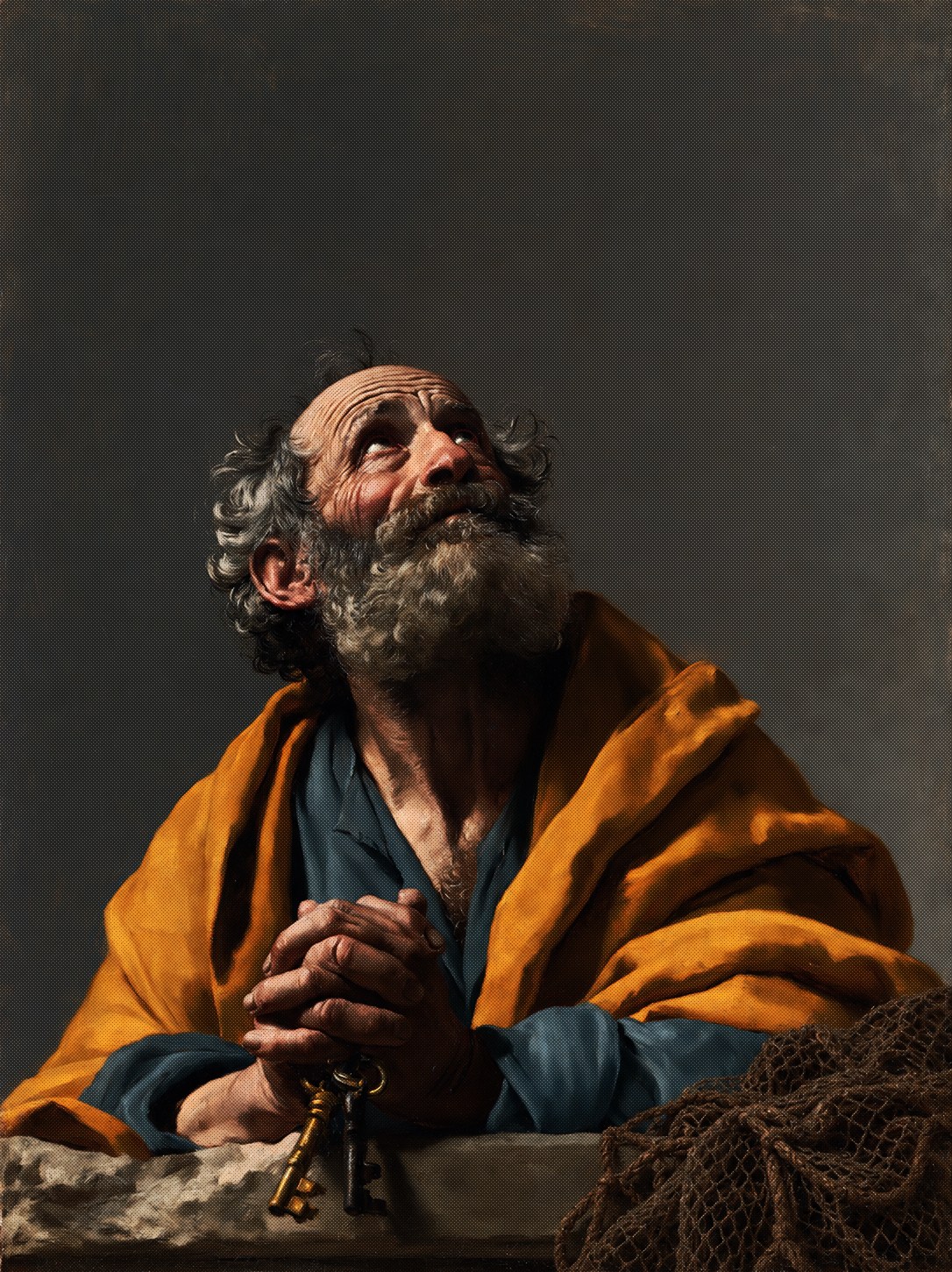
Saint Peter the Apostle
- Born
- c. 1 BC · Bethsaida, Galilee
- Died
- c. AD 64–68 · Rome, Italy
- Feast day
- 29 June
- Canonized
- Pre-Congregation
Patron of
- Vatican City
- Geneva
- Hamburg
- Leuven
- Brno
- Bellinzona
- Angoulême
- Emden
- Ludwigshafen
- Cascia
- Galatina
- reapers
His name was Simon, and it was Jesus who called him Peter. He was born in Bethsaida in Galilee, lived at Capernaum, and worked as a fisherman on the Sea of Galilee, which the Gospels also call the Lake of Tiberias. He was the son of Jonah and the brother of Andrew, and Jesus invited both brothers to follow him. Together with James and John, Peter became one of the three disciples closest to Jesus, present at the raising of the daughter of Jairus, the Transfiguration, and the agony in the garden.
The Gospels draw him as a plain, frank, and sometimes impulsive man. He often spoke and acted on behalf of the apostles, and he was never shy about asking Jesus to explain a parable or a teaching. When many disciples left after Jesus spoke in the synagogue at Capernaum, it was Peter who answered that there was nowhere else to go, since Jesus had the words of eternal life. At Caesarea Philippi he declared that Jesus was the Christ, the Son of the living God. Jesus answered that Simon was Peter, the rock on which he would build his Church, and he promised him the keys of the kingdom of heaven.
The Gospels do not hide his failings. He protested when Jesus spoke about his Passion, he tried to refuse to let Jesus wash his feet at the Last Supper, and after Jesus was arrested he denied three times that he knew him. Yet the other apostles recognized the role Jesus had given him, and the Acts of the Apostles shows him leading the early community. The Gospel of Mark is traditionally thought to reflect his preaching, and two letters in the New Testament carry his name, although many modern scholars doubt that he wrote them.
The New Testament does not describe his journey to Rome. Early Christian writers, including Irenaeus, Tertullian, and Eusebius, report that he spent his last years there, helped Paul found the Church of Rome, and passed on the office of bishop to Linus. They also say he was martyred in Rome under Nero. Tradition holds that he was crucified upside down and buried on Vatican Hill. Late in the second century, a Roman writer named Caius wrote that the monuments of Peter stood at the Vatican. The Church honors Peter and Paul together on 29 June. Peter's tomb lies beneath the basilica that bears his name.
Saint Peter the Apostle, pray for us.
Media

Augustine Institute

Bishop Robert Barron

EWTN

Catholic Online
Art
Saint Peter
Arnolfo di Cambio · c. 1290
Photo by Chabe01 · CC BY-SA 4.0Saint Peter Healing the Sick with His Shadow
Masaccio · 1425
Public domainLiberation of Saint Peter
Raphael · 1514
Public domainCrucifixion of Saint Peter
Caravaggio · 1600
Public domainThe Denial of Saint Peter
Rembrandt · 1660
Public domainLiberation of Saint Peter
Bartolomé Esteban Murillo · 1665
Public domain