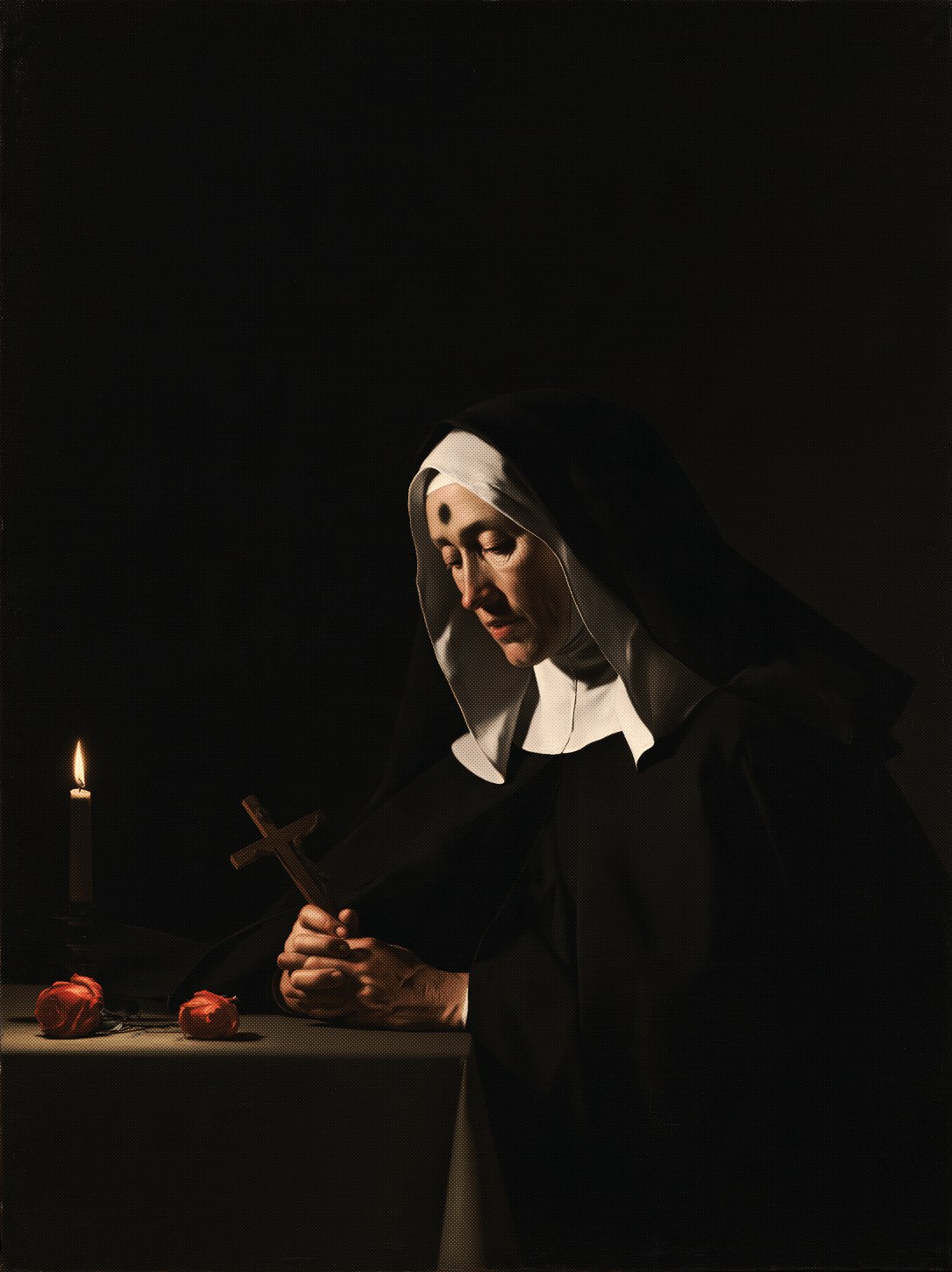
Saint Rita of Cascia
- Born
- c. 1381 · Roccaporena, near Cascia, Umbria, Italy
- Died
- 22 May 1457 · Cascia, Umbria, Italy
- Feast day
- 22 May
- Canonized
- 24 May 1900 · Pope Leo XIII
Patron of
- lost and impossible causes
- sickness
- wounds
- couples and marital problems
- abuse victims
- mothers
- women who wish to have children
- delicatessen sellers
- protection against smallpox
Rita was born in Roccaporena, a small village near Cascia in Umbria, in the later fourteenth century. The exact year is uncertain, and sources give both 1371 and 1381. Her parents were known locally as peacemakers, and they made sure she received a good religious education from the Augustinian friars in nearby Cascia. There she grew attached to Saint Augustine, John the Baptist, and Nicholas of Tolentino, whom she chose as her protectors.
Rita wanted to give her life to God, but her parents arranged a marriage instead. Around 1385 she wed Paolo di Ferdinando di Mancino, a man of violent temper. It was an age of bitter political feuds, and Paolo was drawn into the quarrels of his family. Rita answered him with prayer, patience, and the gift for making peace she had learned at home, and he is said to have slowly grown into a more truly Christian way of life. They had two sons, Giangiacomo and Paolo Maria.
Then Paolo was murdered, a victim of the same feud. Rita forgave his killers, and tradition says she pardoned them in public at his funeral. She hid his blood-stained shirt from her sons so that they would not be tempted to avenge him. The Mancini family kept up its pressure and hostility, and Rita prayed that no more blood would be shed. Then an illness took both boys. Her only comfort was the thought that they had died free of the cycle of revenge.
Left alone, Rita gave herself to prayer for her dead and for the Mancini family, asking that they forgive and find peace. At about thirty-six she asked to join the Augustinian nuns of the monastery of Saint Mary Magdalene in Cascia, and at first she was turned away. She succeeded in reconciling the quarreling relatives, and she was then received into the community.
She lived there for roughly forty years, known for humility, charity, prayer, and penance. For the last fifteen years of her life she bore a wound on her forehead, understood as a sign of her union with the crucified Christ. She died on 22 May, in 1457 according to most accounts.
Her body is venerated in the sanctuary at Cascia, which still draws a steady stream of pilgrims. Pope Urban VIII beatified her in 1626, and Pope Leo XIII canonized her in 1900, naming her patroness of impossible causes. People turn to her in troubled marriages, in grief, and in situations that seem beyond hope.
Saint Rita of Cascia, pray for us.
Media

Saint Rita Shrine

Divine Mercy

Divine Mercy

EWTN
Art
Saint Rita of Cascia
Manuel Navarro · 19th century
Public domainSanta Rita de Casia
Miguel Cabrera
Public domainSaint Rita of Cascia
Public domainStatue of Saint Rita of Cascia, Salvador
Photo by Paul R. Burley · CC BY-SA 4.0Saint Rita of Cascia, Granada
José Risueño
Public domain