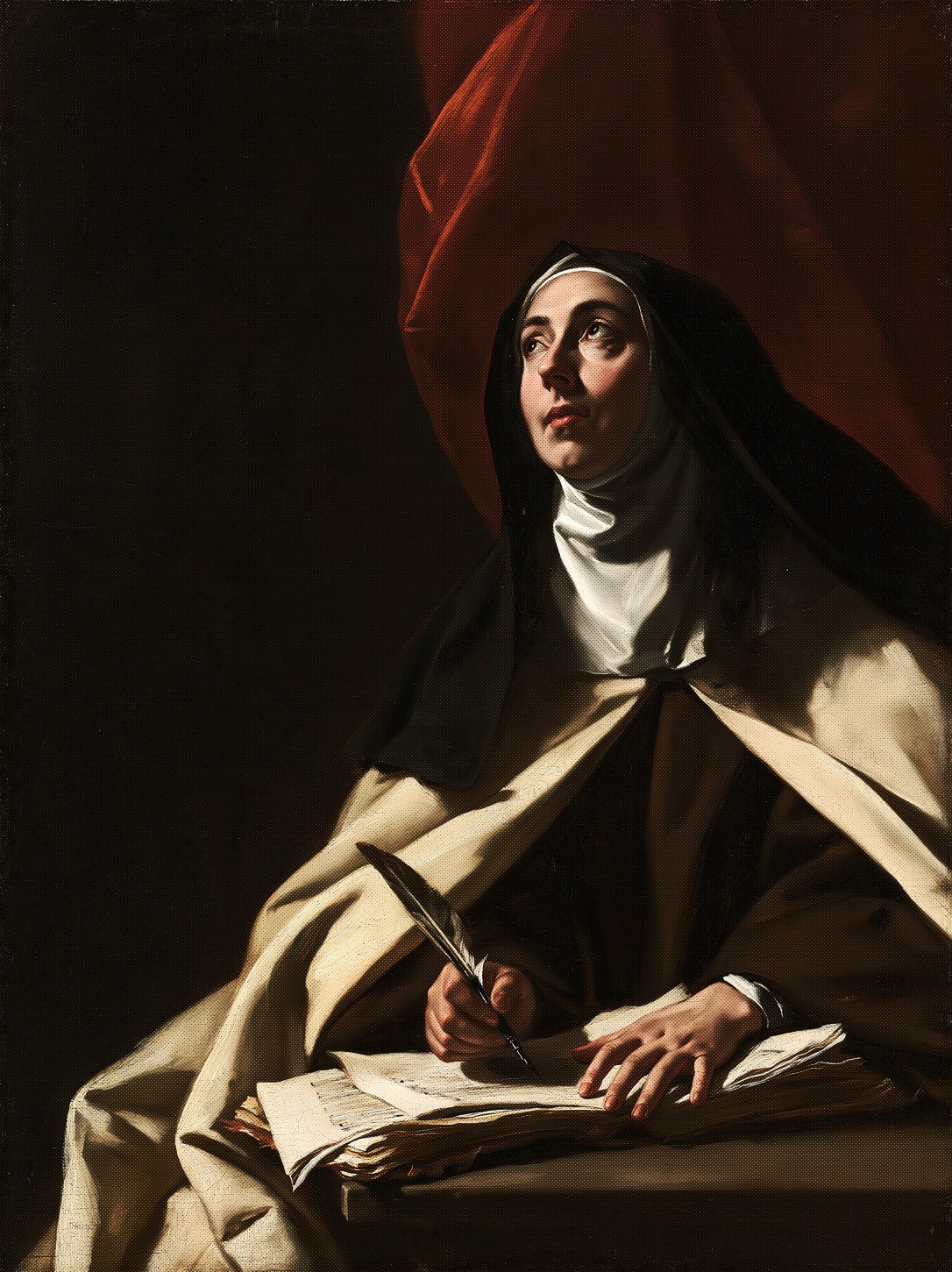
Saint Teresa of Ávila
- Born
- 28 March 1515 · Ávila, Spain
- Died
- 15 October 1582 · Alba de Tormes, Spain
- Feast day
- 15 October
- Canonized
- 12 March 1622 · Pope Gregory XV
Patron of
- Spain
- sick people
- people in religious orders
- people ridiculed for their piety
- Catholic writers of Spain
- lacemakers
- chess
- people with heart ailments
- souls in purgatory
- Naples
- Požega, Croatia
- Subotica, Serbia
In 1562, Teresa of Ávila, a Carmelite nun in her forties, began founding small convents built on poverty, fellowship, and prayer. Over the next twenty years she opened many houses for women, and with the younger friar John of the Cross she helped bring about a reformed branch of Carmelite men.
She was born Teresa Sánchez de Cepeda Dávila y Ahumada on 28 March 1515, at Ávila or nearby Gotarrendura, in Castile. Her father, Alonso Sánchez de Cepeda, was a successful wool merchant and one of the wealthiest men in Ávila; his own father had been a converso, condemned by the Inquisition for allegedly returning to Judaism. Her mother was Beatriz de Ahumada. The home encouraged reading and religious instruction. In her autobiography Teresa recalled her youthful interest in the lives of the saints, which she shared with her brother Rodrigo, and the later pull of chivalric romances, though she wrote these memories many years after the events.
Her mother died when Teresa was a teenager, and for a time she stayed with the Augustinian nuns of Our Lady of Grace in Ávila. She hesitated over religious life, and in her writings she described the struggle between her affections, her fears, and her desire for a consecrated life. In 1535 she entered the Carmelite monastery of the Incarnation at Ávila, over her father's first opposition. She received the habit in 1536 and made her profession on 3 November 1537. The community was large and followed customs different from those she would later propose. A grave illness, with prolonged suffering and periods of immobility, soon interrupted her convent life, and health problems stayed with her through the years of her foundations.
The reform she began took shape around smaller communities, poverty, fellowship, and prayer. From 1562 she promoted many foundations of women, and with John of the Cross she established the Discalced Carmelites. A papal decree in 1580 formally adopted the split from the older order. She endured many troubles along the way. She also wrote. Her works include the Book of Her Life, The Way of Perfection, and The Interior Castle, which describes the soul as a castle with seven mansions.
Teresa died at Alba de Tormes in October 1582. She was beatified in 1614 and canonized forty years after her death, in 1622, by Pope Gregory XV. On 27 September 1970 Pope Paul VI named her the first woman Doctor of the Church.
Saint Teresa of Ávila, pray for us.
Media
Ascension Presents

Ascension Presents

Divine Mercy

EWTN News
Art
Portrait of Saint Teresa of Ávila
Juan de la Miseria · 1576
Public domainSaint Teresa of Ávila's Vision of the Holy Spirit
Peter Paul Rubens · 1614
Public domainSanta Teresa de Jesús
Gregorio Fernández · 1625
Photo by Rodelar · CC BY-SA 3.0Ecstasy of Saint Teresa
Gian Lorenzo Bernini · 1647
Photo by Alvesgaspar · CC BY-SA 4.0Saint Peter of Alcántara Hearing the Confession of Saint Teresa
José García Hidalgo · 1675
Public domainSaint Teresa of Ávila Contemplating the Cross
Domenico Maggiotto · 1745
Public domain