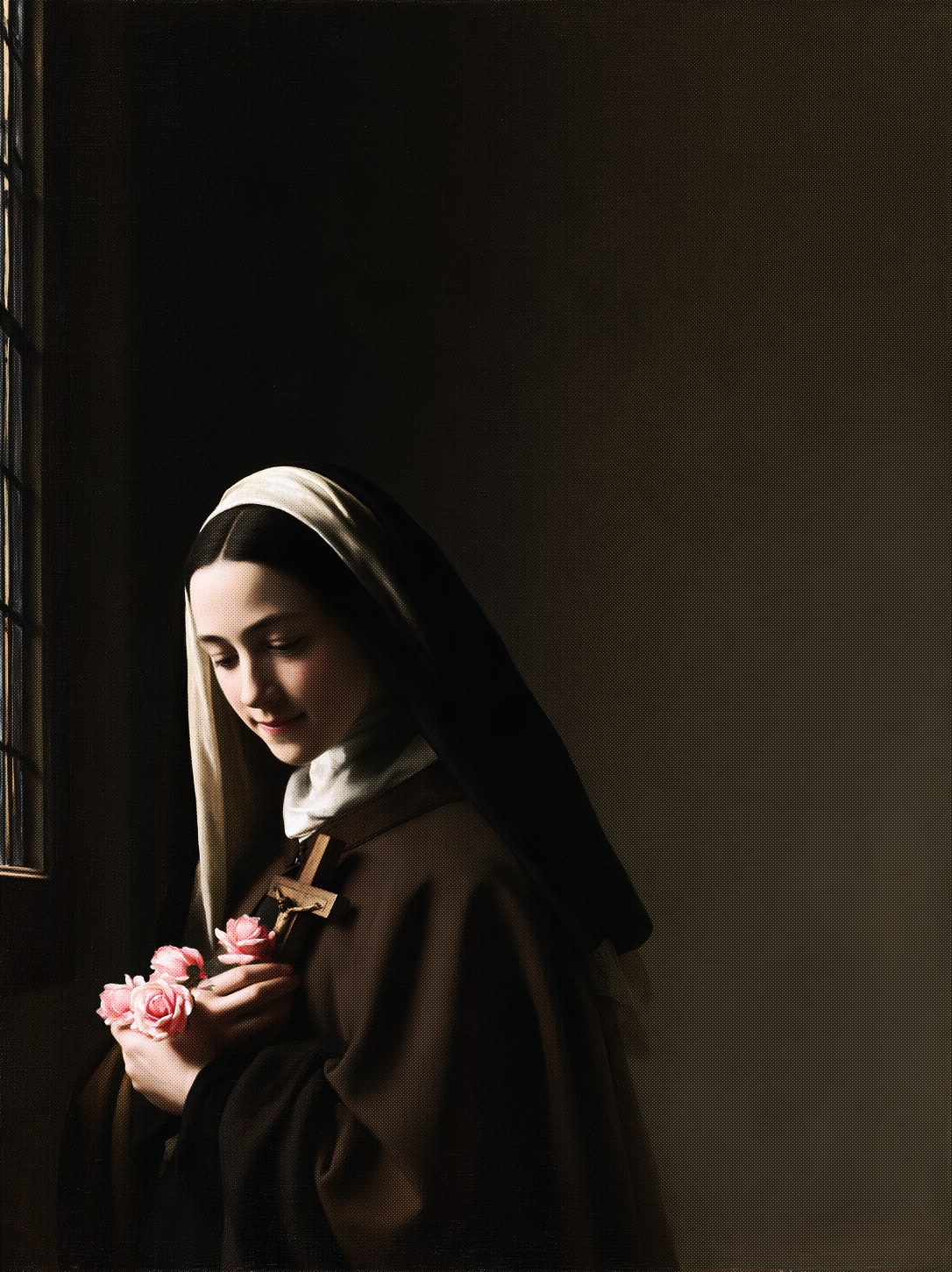
Saint Thérèse of Lisieux
- Born
- 2 January 1873 · Alençon, Normandy, France
- Died
- 30 September 1897 · Lisieux, Normandy, France
- Feast day
- 1 October
- Canonized
- 17 May 1925 · Pope Pius XI
Patron of
- missionaries
- France
- Russia
- Lisieux
- florists and gardeners
- people with tuberculosis
- people who are terminally ill
- orphaned children
- people who are homeless
- aviators
Thérèse Martin was born in Alençon, in Normandy, on 2 January 1873, the youngest of nine children. Four of her brothers and sisters died young, and the five daughters who grew up all became nuns. Her father, Louis, was a watchmaker and jeweler, and her mother, Zélie, was a lacemaker. Both were devout Catholics, and both were later declared saints themselves.
Zélie died of breast cancer in August 1877, when Thérèse was four. Louis moved his daughters to Lisieux, to a house called Les Buissonnets, and the youngest grew up very close to him. She was taught at home and then by the Benedictine nuns of Lisieux. In 1883 a grave illness struck her, and her sisters believed the Virgin Mary had healed her. She made her first communion in May 1884. On Christmas night in 1886, after Mass, she went through what she later called her complete conversion, a release from the oversensitivity of her childhood and, as she saw it, the beginning of real spiritual maturity.
On Pentecost in 1887, at fourteen, she told her father she wanted to enter the Carmelite convent at Lisieux. He agreed. The obstacles came from her age and from the doubts of others, and on a pilgrimage to Rome she asked Pope Leo XIII in person to let her enter early. In 1888, at fifteen, she joined two of her older sisters in the cloister. A third sister, Céline, followed later.
She spent the last nine years of her life in the convent, working as sacristan and helping the novice mistress. Her spiritual life rested on trust in God's merciful love, on humility, and on offering small daily actions with great love. She never left the cloister, yet she understood her calling as a missionary one, lived out through prayer. In her final eighteen months she went through a night of faith, in which she is said to have felt that Jesus was absent and to have been tormented by doubts that God existed. Tuberculosis ended her life on 30 September 1897. She was twenty-four.
Outside Carmel she was almost unknown when she died. Her spiritual memoir, Story of a Soul, was assembled from three manuscripts and heavily edited for publication, and it carried her teaching of the Little Way around the world. Her reputation grew so quickly that she was beatified in 1923 and canonized by Pope Pius XI in 1925, only twenty-eight years after her death. Pope Pius X had called her the greatest saint of modern times, and in 1997 Pope John Paul II named her a Doctor of the Church. After Lourdes, the basilica at Lisieux is the most visited pilgrimage site in France. She is remembered for showing that holiness could be found in the ordinary duties of a short, hidden life.
Saint Thérèse of Lisieux, pray for us.
Media

Bishop Robert Barron

Ascension Presents

Ascension Presents

Divine Mercy
Art
Thérèse of Lisieux at Fifteen
c. 1888
Public domainThérèse of the Child Jesus
1895
Public domainSainte Thérèse de Lisieux
Public domainSainte Thérèse, Sainte-Agnès
Photo by Laurent Seignobos · CC BY-SA 4.0Statue of Saint Thérèse of Lisieux, Houchin
Louis Richomme
Photo by Etienne5962 · CC BY-SA 4.0