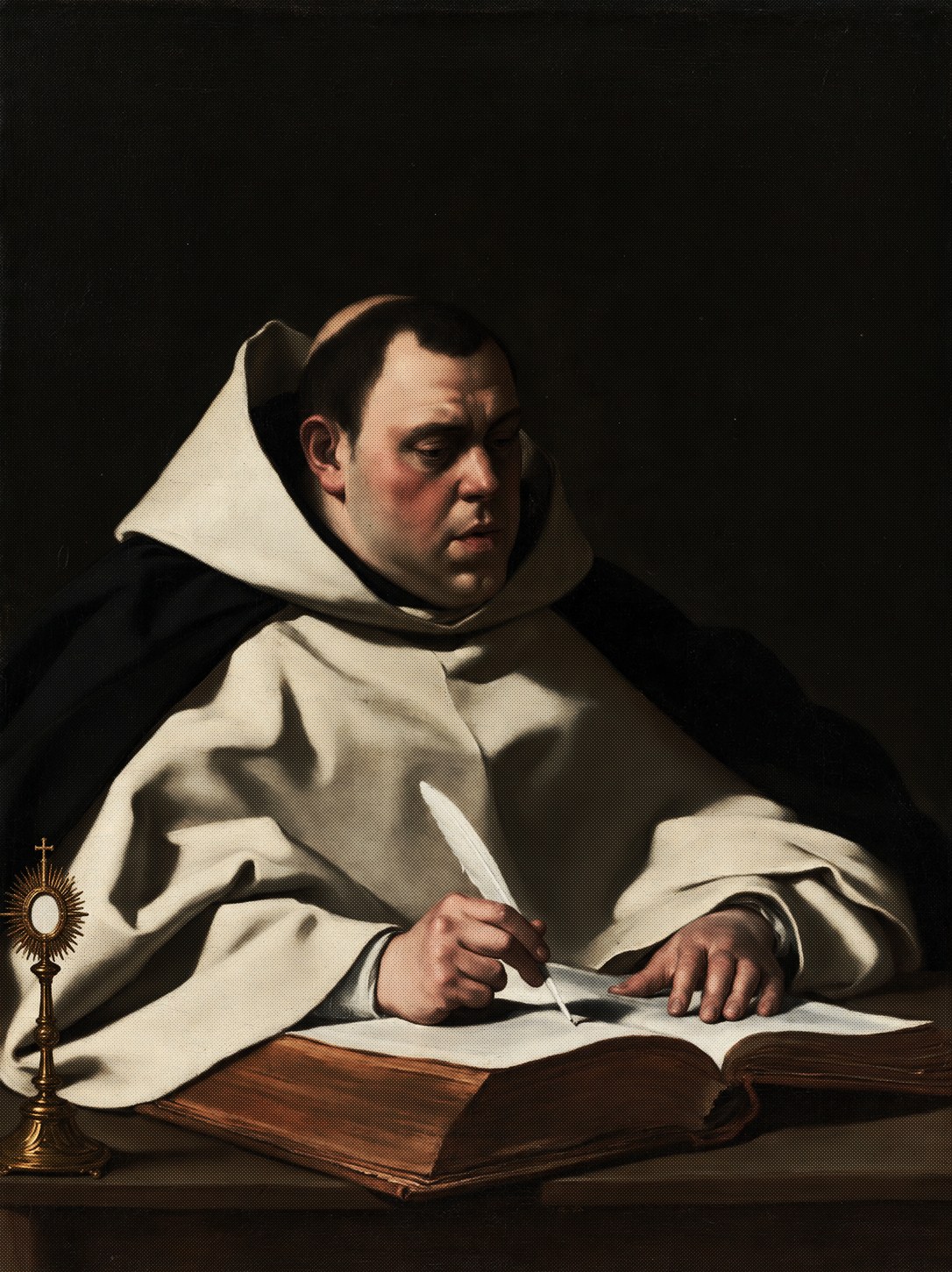
Saint Thomas Aquinas
- Born
- c. 1225 · Roccasecca, Kingdom of Sicily (Lazio, Italy)
- Died
- 7 March 1274 · Fossanova, Papal States (Lazio, Italy)
- Feast day
- 28 January
- Canonized
- 18 July 1323 · Pope John XXII
Patron of
- theologians
- philosophers
- students
- scholars
- academics
- Catholic schools and universities
- booksellers
- publishers
- pencil makers
- apologists
- chastity
- Aquino, Italy
Thomas was born around 1225 in the family castle of Roccasecca, in what is now southern Lazio. His father, Landulf of Aquino, was a knight in the service of the emperor Frederick II, and his mother, Theodora, came from a noble family of Naples. When Thomas was about five, his family sent him to the abbey of Montecassino as an oblate, hoping that he would become a monk and one day an abbot, an office that would bring honor to a rich and noble house.
He had other plans. After leaving the monastery as a teenager, he went to the University of Naples to study philosophy, and there he grew drawn to the Dominicans. The order was one of the new mendicant orders, as poor as the Franciscans, with nothing noble about it. By 1244 he had decided to join them, and his relatives did all they could to stop him. His brothers went after him, and a family tradition remembers him escaping them. In the end he crossed the Alps and reached Paris, where Dominican masters and brothers were waiting.
In Paris he studied under Albert the Great, who quickly saw the quality of his mind. Thomas was so quiet that his classmates called him the dumb ox, and Albert is said to have answered that the ox would one day bellow so loudly that the whole world would hear him. Thomas followed his teacher to Cologne as well, and in time he began to teach in Paris himself.
His writing was vast. It includes the Disputed Questions on Truth, the Summa contra Gentiles, and many commentaries on Scripture and on Aristotle. His best-known work is the Summa Theologiae, which he began in 1265 and never finished. He welcomed much of Aristotle's philosophy and worked to bring it together with the Christian tradition. He also wrote the Eucharistic hymns that are still part of the Church's liturgy. His admirers noted that he lived what he studied, and that his words and actions matched.
In 1274 Pope Gregory X invited him to the Second Council of Lyon. Thomas died on the way, on 7 March, at the Cistercian monastery of Fossanova in Lazio. Years later his body was moved to Toulouse, where it rests in the Church of the Jacobins. He was canonized at Avignon in 1323 by Pope John XXII, and he is one of the Doctors of the Church, known as the Angelic Doctor. His thought has shaped Catholic theology and philosophy ever since.
Saint Thomas Aquinas, pray for us.
Media

The Thomistic Institute

Bishop Robert Barron

Bishop Robert Barron
Matt Fradd
Art
Triumph of Saint Thomas Aquinas
Lippo Memmi · 1340
Public domainSaint Thomas Aquinas
Fra Angelico · 1442
Public domainSaint Thomas Aquinas
Carlo Crivelli · 1476
Public domainThe Apotheosis of Saint Thomas Aquinas
Francisco de Zurbarán · 1631
Public domainTemptation of Saint Thomas
Diego Velázquez · 1632
Public domainSaint Thomas Aquinas Writing the Hymn of the Holy Sacrament
Guercino · 1662
Public domain