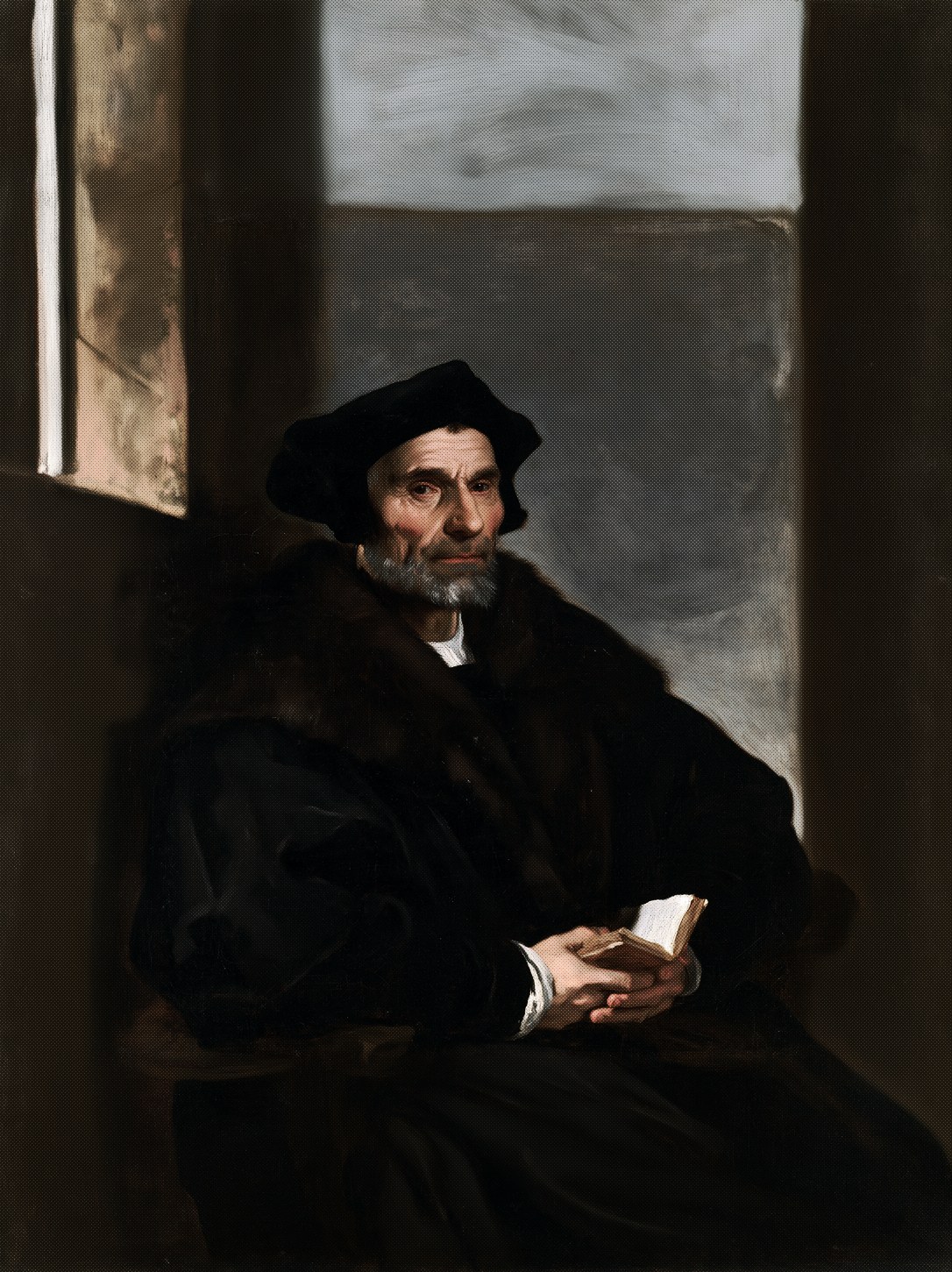
Saint Thomas More
- Born
- 7 February 1478 · London, England
- Died
- 6 July 1535 · Tower Hill, London, England
- Feast day
- 22 June
- Canonized
- 19 May 1935 · Pope Pius XI
Patron of
- politicians
- statesmen
Thomas More was born in London on 7 February 1478, the second of six children of John More, a lawyer who later became a judge, and his wife Agnes. He was educated at St. Anthony's School, then counted among the best in the city, and as a teenager he served as a page in the household of John Morton, Archbishop of Canterbury and Lord Chancellor. Morton was a supporter of the new humanist learning and thought highly of the boy. He nominated him for a place at the University of Oxford.
More became a lawyer like his father, and his career was crowded: member of Parliament, diplomat, judge, Speaker of the House of Commons. In 1516 he published Utopia, a description of the political system of an imaginary island that gave English the word for an ideal society. Scholars across Europe admired him, and Erasmus dedicated his Praise of Folly to him. People in London knew him as a generous man with a quick sense of humor. At home he married Jane Colt, who bore him four children, and after she died he married Alice Middleton. He took great care over the education of his children, in learning and in faith, and kept his house open to friends. In his younger years he had lived close to the Franciscans of Greenwich and spent a period with the Carthusians of London.
As a royal councillor and secretary he worked against the Protestant Reformation, and he helped Henry VIII with the book defending the seven sacraments that earned the king the title Defender of the Faith. In 1529 he became Lord Chancellor, the first layman to hold the office. But the king was determined to marry Anne Boleyn and had his marriage to Catherine of Aragon declared void, and in the quarrel with Pope Clement VII that followed, Henry took the leadership of the Church in England for himself. More resigned in 1532, and his family was left in poverty.
In 1534 the Act of Supremacy and the Act of Succession made the break law. More had already withdrawn from public life, but he could not approve the new order and would not renounce his loyalty to the pope. He was imprisoned in the Tower of London, and no pressure moved him. Convicted of treason on evidence that he said was false, he was executed on Tower Hill on 6 July 1535. He is reported to have said that he died the king's good servant, but God's first.
Pope Pius XI canonized More in 1935, together with John Fisher, the bishop of Rochester, who had been executed a few weeks before him. In 2000 Pope John Paul II named him patron of statesmen and politicians, holding up his conscience as an example for public life.
Saint Thomas More, pray for us.
Media

Bishop Robert Barron

Bishop Robert Barron

Catholic Online
The Coming Home Network International
Art
Portrait of Sir Thomas More
Hans Holbein the Younger · 1527
Public domainSir Thomas More
1579
Public domainSir Thomas More and Family
Rowland Lockey · 1593
Public domainSir Thomas More
c. 1600
Public domainThomas More, Lord High Chancellor of England
Claudius Jacquand · 1828
Public domainSir Thomas More and His Daughter
John Rogers Herbert · 1844
Public domain