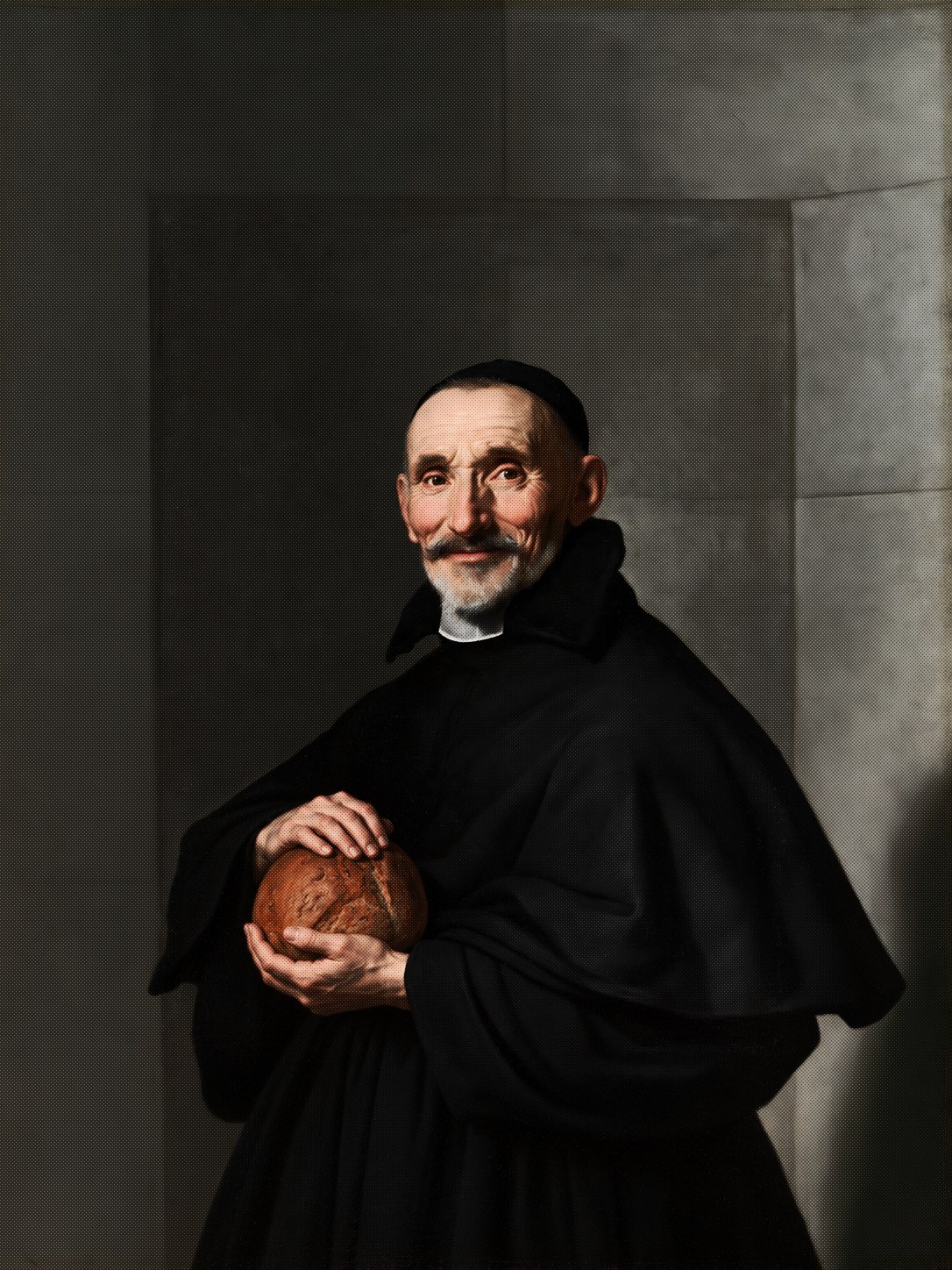
Saint Vincent de Paul
- Born
- 24 April 1581 · Pouy, Gascony, France
- Died
- 27 September 1660 · Paris, France
- Feast day
- 27 September
- Canonized
- 16 June 1737 · Pope Clement XII
Patron of
- charities
- prisoners
- orphans
- foundlings
- slaves
- hospitals
- volunteers
- leprosy
- horses
- lost articles
- Dax
- Madagascar
Vincent de Paul was born on 24 April 1581 at Pouy, in Gascony, into a family of peasant farmers. His father was Jean de Paul and his mother was Bertrande de Moras. He was the third child and showed a gift for learning early, but until he was fifteen he worked in the fields and looked after the family's livestock, pigs among them. Then his father sold the family's oxen to pay for his schooling. In 1595 Vincent left home for the Franciscan college at Dax. A local judge and lawyer, de Comet, was so struck by his sharp mind that he took him into his house to teach his sons.
Vincent received the tonsure and minor orders on 20 December 1596 and went on to study theology at the University of Toulouse. On 23 September 1600, at only nineteen, he was ordained a priest by an elderly bishop of Périgueux, at a time when the rules of the Council of Trent were not yet in force in France. He took his degree in October 1604. For a while he hoped in vain for a parish income. His father died and the family fell into deeper poverty, and the private school he opened to help them did poorly and left him in debt.
Then came an adventure that remains controversial. In late July 1605, on a sea voyage from Marseille to Narbonne, his ship was attacked by Turkish pirates. Vincent was taken to Tunis and sold as a slave. He spent about two years in captivity and escaped in 1607, and the traditional account says he brought his own master to the faith and was freed by him. The experience left him with a desire to bring material and spiritual relief to the convicts who rowed the galleys.
In 1612 he became a parish priest near Paris, and he also served in the royal court, but gradually he gave himself to the poor. In 1617 he founded the Ladies of Charity, and in 1622 he was appointed chaplain to the galley slaves in Paris. In 1625 he founded the Congregation of the Mission, known as the Vincentians or Lazarists, whose priests took vows of poverty, chastity, obedience, and stability to serve people in small towns and villages. He gave retreats for clergy at a time when many priests were lax, and he was a pioneer in seminary education. With Louise de Marillac he founded the Daughters of Charity in 1633. He spoke up for the rights of the poor before the powerful and promoted a simple, popular way of preaching the Gospel.
Vincent died in Paris on 27 September 1660. In France he was known as Monsieur Vincent. He is remembered for seeing the face of Christ in every person who suffered, and for the compassion, humility, and generosity with which he served the poor.
Saint Vincent de Paul, pray for us.
Media

Breaking In The Habit

Mission and Ministry DePaul University
Art
Saint Vincent de Paul at the Deathbed of Louis XIII
Jean-François de Troy · 1731
Public domainStatue of Saint Vincent de Paul
Josef Dietrich · 1745
Photo by Matěj Baťha · CC BY-SA 3.0Saint Vincent de Paul Taking the Chains of a Galley Slave
Fortuné Dufau · 1808
Photo by PMRMaeyaert · CC BY-SA 4.0Saint Vincent de Paul Preaching to the Court of Louis XIII on Behalf of the Abandoned Children
Paul Delaroche · 1823
Public domainSaint Vincent de Paul
Jean-Léon Gérôme · 1847
Public domain